Temples in Kyoto · Higashiyama, Kyoto
Sennyu-ji Temple
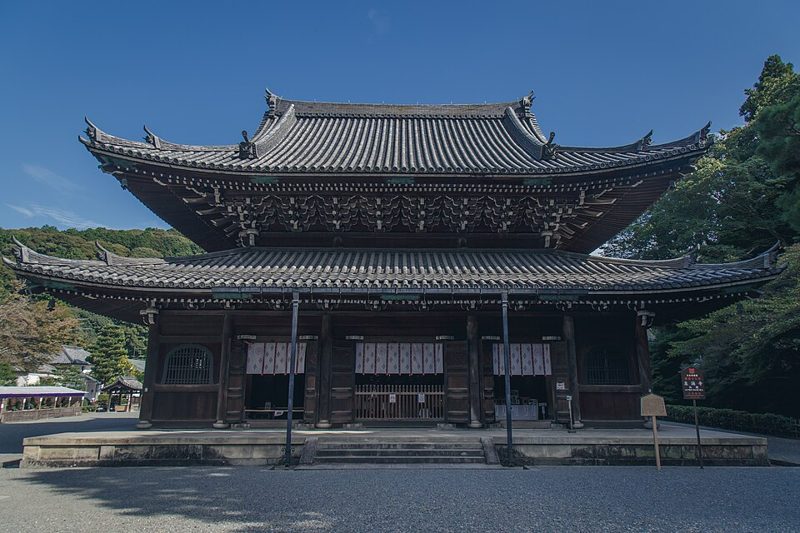
In 1242, the funeral of Emperor Shijo transformed Sennyu-ji into a temple with an extraordinary relationship to Japan's imperial family. The Buddhist complex had been completed in 1226 under the monk Shunjo, who studied in Song China for 12 years. Its name commemorates the spring discovered during construction, which the temple says continues to flow today.
Kyochika's take
Kyochika recommends Sennyu-ji for travelers interested in imperial history, Buddhist architecture, and the exchange of religious ideas between Japan and China. Begin at the main gate and pay attention to the unusual descending approach, which leads toward the Buddha Hall rather than climbing toward it.
For an autumn visit, consider combining the central buildings with the special-admission Gozasho Garden, when accessible. The temple's official description identifies autumn foliage and spring greenery as characteristic seasonal features.
Hours, admission and access
- Hours
- March–November: admission 9:00–16:30, gates close 17:00. December–February: admission 9:00–16:00, gates close 16:30.
- Closed
- The Shinshoden Treasure Hall closes on the fourth Monday of every month. Individual facilities may be unavailable during ceremonies or other temple events.
- Admission
- Main precincts: adults ¥500; elementary and junior high school students ¥300. Special admission: ¥500 for junior high school students and older. Elementary school children and younger must be accompanied for special admission.
- Access
- Approximately 20 minutes on foot from Tofukuji Station on the JR Nara Line or Keihan Railway. Kyoto City Bus 208 from Kyoto Station to Sennyuji-michi, followed by approximately 15 minutes on foot. Approximately 10 minutes by taxi from Kyoto Station Hachijo Exit.
- Nearest station
- Tofukuji Station
Checked against official information on 2026-10-28. Details change, so check the official website before you go.
Sources: Sennyu-ji Official Website, Sennyu-ji Official Visiting Guide, Sennyu-ji Official History, Sennyu-ji and the Imperial Family, Sennyu-ji Cultural Properties
 Pochikichi's story corner
Why did Sennyu-ji become the Imperial Temple?
Sennyu-ji's history begins with an earlier religious foundation. The temple's official account states that in 855 the aristocrat Fujiwara no Otsugu gave a mountain residence to the monk Shinshu, establishing an institution eventually known as Senyu-ji. Another tradition connects the site with the Buddhist teacher Kobo Daishi, who is said to have established a hermitage in the area. These traditions belong to the temple's account of its early origins and should not be confused with the documented construction of the later monumental complex.
The defining transformation was led by Shunjo, also honored as Gachirin Daishi. Born in Higo, in present-day Kumamoto Prefecture, he traveled to Song China and spent 12 years studying Buddhist traditions. Returning to Japan, he devoted himself to reviving Buddhist monastic discipline. In 1218, Utsunomiya Nobufusa donated land to him. Shunjo secured substantial support, including contributions associated with Retired Emperor Gotoba and Retired Emperor Gotakakura. Construction proceeded according to architectural and religious ideas learned in China, and the principal complex was completed in 1226.
Shunjo established a center that combined Buddhist discipline with the study of Tendai, Shingon, Zen, and Pure Land teachings. This combination made the institution a meeting place for traditions that are often encountered separately today. During the building works, water emerged from the ground, giving the temple its present name. The original spring remains protected by a shelter rebuilt in 1668. Its existence connects the physical landscape with the religious foundation.
Imperial history reshaped the temple's identity. When Emperor Shijo died in 1242, his funeral took place at Sennyu-ji and a mausoleum was established nearby. Later emperors and imperial consorts were also commemorated or buried in the eastern hills. The temple acquired the designation Mitera, or Imperial Temple. Its Reimei-den preserves imperial memorial tablets, while the Gozasho served members of the imperial family. These buildings continue to embody Sennyu-ji's ceremonial role. When you visit, look for the relationship between the Buddhist halls, the imperial residential buildings, and the memorial landscape beyond them.
Sources: Sennyu-ji Official History, Sennyu-ji and the Imperial Family, Sennyu-ji Cultural Properties
Long ago, around hereWhat occupied this hillside before the imperial complex?
Around 1,200 years ago, the monumental Buddhist complex associated with Shunjo had not yet been constructed. The temple's historical account places an early foundation in 855, when Fujiwara no Otsugu provided a residence for the monk Shinshu. Another tradition associates the area with Kobo Daishi. The surviving accounts establish the religious importance attributed to the location but do not provide a complete architectural plan of the earliest buildings.
Around 400 years ago, Sennyu-ji was already established as a center of imperial memorial observances. Its architecture continued to evolve: the main Buddha Hall and spring shelter were rebuilt in 1668. Around 150 years ago, the temple was approaching another period of architectural change. In 1882, a fire destroyed its imperial memorial hall and other buildings, and reconstruction followed under imperial direction. The Gozasho was transferred from Kyoto Imperial Palace, preserving a direct architectural link with the former imperial residence.
Sources: Sennyu-ji Official History, Imperial History, Cultural Properties
Hidden highlights
- The descending approach
- The main gate occupies the highest part of the central temple precinct. From here the path descends toward the Buddha Hall, creating an architectural perspective that differs from a conventional uphill temple approach.
- The spring shelter
- Rebuilt in 1668, this roofed structure protects the spring that gave Sennyu-ji its name. Its roof incorporates traditional Japanese construction details, while the interior ceiling contains a dragon painting attributed to Bessho Jokan.
- The Three Buddhas
- Inside the Buddha Hall, Amitabha, Shakyamuni, and Maitreya represent past, present, and future. The temple identifies this arrangement as a comparatively unusual Japanese example influenced by Song-period Buddhist practice.
- Kano Tanyu's paintings
- The Buddha Hall contains a dragon ceiling painting, images of heavenly beings, and a White-Robed Kannon painting attributed by the temple to Kano Tanyu. Together they reveal how painting and architecture were conceived as part of one sacred interior.
- The Buddhist tooth relic
- The Shariden preserves a tooth relic traditionally brought from Song China by the monk Tankai in 1228. The temple explicitly identifies the Shariden interior as closed to the public.
- Gozasho Garden
- The imperial residential garden combines a pond, planted slopes, seasonal foliage, and stone elements. It forms part of the special-admission area and is best understood alongside the historical rooms of the Gozasho.
Sources: Sennyu-ji Cultural Properties, Sennyu-ji Visiting Guide
The spring that gave the temple its name
The name Sennyu-ji preserves the memory of a discovery made during the construction of Shunjo's monastery. According to the official temple history, a spring emerged from the ground while the Buddhist halls were being established. Water became part of the institution's identity, not simply a practical resource.
The spring remains protected by a shelter reconstructed in 1668. The temple states that the water has continued to flow. This gives visitors a direct connection with the medieval foundation: beyond the imperial memorials and major halls, the institution still remembers the spring around which its name was formed.
Sources: Sennyu-ji Official History, Sennyu-ji Cultural Properties
A sacred tooth and a story told through Noh
The Shariden is associated with a tooth relic of the Buddha brought from Song China by Tankai, a disciple of Shunjo, in 1228. The temple also preserves guardian figures associated with the relic. The annual relic ceremony commemorates the sacred object's arrival.
The relic appears in the Noh play Shari. In the story, the sacred tooth is stolen and recovered through the intervention of Idaten, a protective deity. The connection demonstrates how objects preserved in Buddhist institutions could become the foundation of stories performed in Japan's classical theater.
Sources: Sennyu-ji Cultural Properties
How to walk it
- Daimon Gate — Examine the former imperial-palace gate and its carved decorative details. (5 min)
- Descending approach — Follow the unusual descending approach and study how the Buddha Hall is framed by the precinct. (5 min)
- Butsuden — Observe the Zen-style architectural details and, where viewing is permitted, the Three Buddhas of Time. (15 min)
- Sennyuji spring shelter — Find the historic shelter preserving the water source that named the temple. (5 min)
- Shariden exterior — Consider the importance of the Buddhist relic preserved within this normally closed building. (5 min)
- Yokihi Kannon Hall — Visit the hall included in the main admission area and examine the temple's Kannon tradition. (10 min)
- Gozasho and garden — If special admission is available, explore the former imperial residential spaces and garden. (20 min)
- Shinshoden — If open, visit the treasure hall to complete the historical context. (15 min)
All durations are Kyochika estimates, not official walking times. Some interiors are closed, and special admission may be suspended for ceremonies. Check the permitted route at the entrance.
Sources: Sennyu-ji Cultural Properties, Sennyu-ji Visiting Information
Through the seasons
- Spring
- Fresh green leaves around the buildings and garden, a seasonal feature highlighted in the temple's official history.
- Summer
- The tree-covered temple precinct and its historic architecture. Plan for outdoor walking conditions.
- Autumn
- Autumn foliage around the principal buildings and Gozasho Garden, as described on the official website.
- Winter
- The Buddha Hall and other architectural features remain the focus of a winter visit. Seasonal admission closes earlier.
Getting there by taxi or bus
- Taxi
- Approximately 10 minutes from Kyoto Station Hachijo Exit, according to the temple's official access guide.
- Bus
- Kyoto City Bus 208 from Kyoto Station to Sennyuji-michi (泉涌寺道), followed by approximately 15 minutes on foot. Kyoto City Bus 207 from the Gion-Shijo area also serves Sennyuji-michi (泉涌寺道).
- Other
- Approximately 20 minutes on foot from Tofukuji Station on JR or Keihan Railway.
Sources: Sennyu-ji Official Access Guide
Pair it with
- Unryu-in Temple — A temple within the Sennyu-ji mountain complex that offers another perspective on the area's Buddhist traditions.
- Imakumano Kannon-ji Temple — Another temple listed as part of the Sennyu-ji mountain complex, associated with Kannon devotion.
- Kaiko-ji Temple — A subtemple identified in Sennyu-ji's official list of associated temples.
Good to know before you go
- The main-precinct admission and special admission are separate categories.
- The main admission includes the Daimon, Buddha Hall, Yokihi Kannon Hall, spring shelter, Shariden area, and Shinshoden.
- Some listed buildings are not open internally.
- The Shariden and Reimei-den interiors are not open to the public.
- The Shinshoden Treasure Hall closes on the fourth Monday of every month.
- Special viewing may be suspended without advance notice for imperial visits or ceremonies.
- Groups are asked to make reservations where possible.
- Groups consisting of high school students or younger are not accepted for special admission.
- Photography and video recording inside buildings are prohibited.
- Remove hats inside the halls.
- Do not touch exhibits or enter restricted spaces.
- Visitors under the influence of alcohol are not admitted.
- Follow temple staff instructions.
- Card-payment acceptance, luggage storage, and English-language audio-guide availability were not confirmed in the official visitor information.
Next stop: book for later today PR
Tickets and experiences in Kyoto you can book on Klook. Filter by “Today” to see what is still open.
Kimono rental in Kyoto→Tea ceremony experiences in Kyoto→Kyoto one-day sightseeing tours→All things to do in Kyoto on Klook →Compare on GetYourGuide: Kimono rental in Kyoto · Tea ceremony experiences in Kyoto · Kyoto one-day sightseeing tours
Ad: Klook and GetYourGuide affiliate links.
🍜 Where to eat after
Restaurants near here on Google Maps→Many restaurants in Kyoto take reservations, and some are cash only. Check the restaurant page before you go.
Events nearby
Festival & seasonal event
Unryuin Temple Autumn Special Opening and Light-up
Unryuin Temple (Sennyuji) (Tofukuji Sta.)
Nov 14 (Sat) – Nov 30 (Mon) 09:00 – 17:00
A quiet hidden spot for autumn leaves in Higashiyama, a sub-temple of the imperial family temple Sennyuji. The usually hidden Fudo Myoo triad is unveiled, and garden maples can be viewed from the study halls. On November 20-23 the temple is lit from sunset to 9:00 PM, and the four shoji windows of the Renge-no-ma room frame camellia, a lantern, maples and pine. No day/night changeover; last entry 4:30 PM by day, 8:30 PM at night.
Details →Festival & seasonal event
Ryoginan (National Treasure) Autumn Special Opening at Tofukuji
Ryoginan, a sub-temple of Tofukuji (Tofukuji Sta.)
Nov 7 (Sat) – Dec 6 (Sun) 09:00 – 16:30 (details on the official site)
A special autumn opening of Ryoginan, timed with Tofukuji's maple-viewing season. See the abbot's hall, the oldest surviving building of its kind and a National Treasure, and three gardens by Shigemori Mirei: the bare white-sand 'Garden of Nothingness', the 'Dragon Garden' where stones show a dragon rising from the sea through black clouds, and the 'Garden of Inseparability' tied to a childhood legend of the founder Mukan Fumon. Last entry 16:00.
Details →Festival & seasonal event
Special Autumn Foliage Viewing 2026 at Tentokuin Temple
Tentokuin Temple (Tofukuji Sta.)
Nov 14 (Sat) – Dec 6 (Sun) 09:00 – 20:30
A special viewing of moss gardens and autumn leaves at a subtemple of Tofukuji. Admission is accepted until 8:00 PM, with illumination beginning around 4:00 PM.
Details →Festival & seasonal event
Chisan Momijitsuki: Autumn Leaves Light-up at Chishakuin
Chishakuin Temple (Shichijo Sta.)
Nov 7 (Sat) – Dec 6 (Sun) 17:00 – 21:00
A new autumn light-up at Chishakuin, head temple of the Chisan school of Shingon Buddhism. Colored maples are joined by 3,000 bamboo lanterns filling the grounds and a sea of mist clouds, created by the team behind Arashiyama Tsukitoro and Toji Tsukikairo. Last entry 8:40 PM; tickets on sale daily from 5:00 PM on the grounds.
Details →
Tips from visitors
Been here? Leave a short tip for the next traveler — in any language. No name, no sign-up.
Thank you! We check every tip by hand and post it within a day or two.
How we post tips: we read every one before it goes up. We remove swear words, insults, ads, links and anything that could identify a person. Tips are shown in the language they were written in, with a translate link. Kyochika never writes or pays for tips, and there are no star ratings.
FAQ
- What is Sennyu-ji Temple?
- In 1242, the funeral of Emperor Shijo transformed Sennyu-ji into a temple with an extraordinary relationship to Japan's imperial family. The Buddhist complex had been completed in 1226 under the monk Shunjo, who studied in Song China for 12 years. Its name commemorates the spring discovered during construction, which the temple says continues to flow today.
- Hours at Sennyu-ji Temple?
- March–November: admission 9:00–16:30, gates close 17:00. December–February: admission 9:00–16:00, gates close 16:30.
- Closed at Sennyu-ji Temple?
- The Shinshoden Treasure Hall closes on the fourth Monday of every month. Individual facilities may be unavailable during ceremonies or other temple events.
- Admission at Sennyu-ji Temple?
- Main precincts: adults ¥500; elementary and junior high school students ¥300. Special admission: ¥500 for junior high school students and older. Elementary school children and younger must be accompanied for special admission.
- Access at Sennyu-ji Temple?
- Approximately 20 minutes on foot from Tofukuji Station on the JR Nara Line or Keihan Railway. Kyoto City Bus 208 from Kyoto Station to Sennyuji-michi, followed by approximately 15 minutes on foot. Approximately 10 minutes by taxi from Kyoto Station Hachijo Exit.
- Why is Sennyu-ji known as the Imperial Temple?
- Emperor Shijo's funeral was held here in 1242, and later imperial funerals and burials strengthened the relationship with the imperial family.
- Can visitors enter the imperial residential rooms?
- The Gozasho, Gozasho Garden, and Kaie-do are included in special admission, subject to access restrictions and ceremonies.
- Does the spring that gave Sennyu-ji its name still exist?
- Yes. The temple states that it continues to flow beneath a historic shelter rebuilt in 1668.
- Is photography permitted inside the buildings?
- No. The temple's official visitor regulations prohibit photography and video recording inside buildings.