Temples in Kyoto · Shimogyo, Kyoto Station Area
Nishi Hongwanji Temple
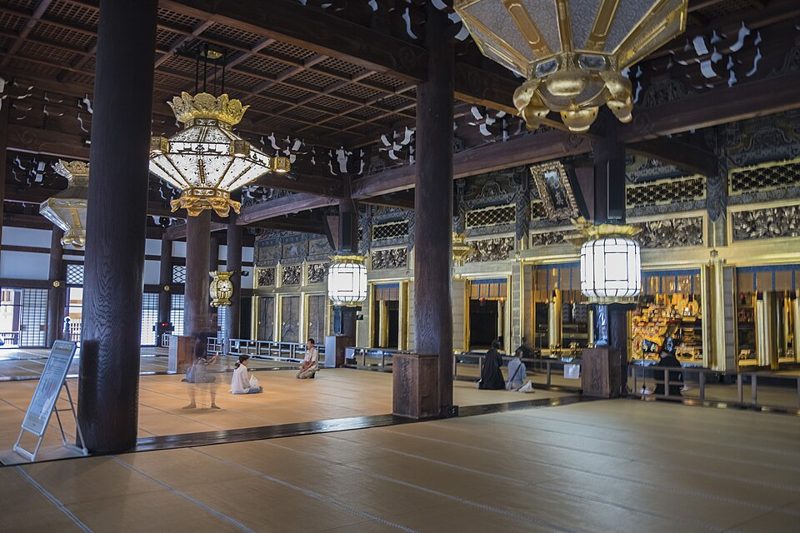
Nishi Hongwanji's enormous Founder's Hall was rebuilt in 1636 and measures 62 by 48 meters, rising 29 meters high. The temple is the headquarters of Jodo Shinshu Hongwanji-ha and contains National Treasure buildings, including its two great halls, richly decorated Shoin, Karamon gate, and Hiunkaku pavilion. Inscribed as part of Kyoto's UNESCO World Heritage in 1994, the complex preserves the history of a Buddhist movement that once fought Oda Nobunaga and later divided into western and eastern institutions.
Kyochika's take
Kyochika recommends Nishi Hongwanji to travelers interested in the relationship between Buddhist teaching, religious communities, and monumental Japanese architecture. Begin by comparing the two main halls: one centers on the image of Shinran, while the other enshrines Amida Buddha.
For visitors interested in living religious practice, the official daily morning service begins at 6:00 and is open to the public. Kyochika suggests considering this experience rather than treating the site only as an architectural landmark. Visitors should follow temple instructions and respect participants in worship.
Hours, admission and access
- Hours
- 5:30–17:00, according to the official English FAQ.
- Closed
- No regular closing day is listed in the official English visitor FAQ. Access to particular buildings may be restricted.
- Admission
- Free general admission.
- Access
- 10 minutes on foot from Kyoto Station. Kyoto City Bus 9, 28 or 75 from Kyoto Eki-mae to Nishi Hongwanji-mae.
- Nearest station
- Kyoto Station
Checked against official information on 2026-10-28. Details change, so check the official website before you go.
Sources: Nishi Hongwanji Official Website, Nishi Hongwanji Official English Website, Nishi Hongwanji Official History, Nishi Hongwanji Official English Precinct Guide, Nishi Hongwanji Official Architectural Guide, Nishi Hongwanji Official Shoin and Noh Stages, Jodo Shinshu Hongwanji-ha Official English FAQ, Jodo Shinshu Hongwanji-ha Official English Access
 Pochikichi's story corner
How did a memorial for Shinran become the headquarters of a major Buddhist tradition?
The history of Hongwanji begins with Shinran, founder of the Jodo Shinshu tradition. Shinran lived from 1173 to 1263. Following his death, a stone memorial was erected in the Otani area of eastern Kyoto to hold his remains. His daughter Kakushinni and followers from eastern Japan sought a more substantial place of remembrance. In 1272, a hexagonal memorial hall was established, containing an image of Shinran and his remains. Kakushinni provided the land and became responsible for the memorial's guardianship. This mausoleum became the starting point of the institution later known as Hongwanji.
Over generations, the memorial developed into an organized religious community. The name Hongwanji came into official use around 1321. Kakushinni's descendants played important roles in preserving Shinran's teaching and maintaining the institution. Under Rennyo, who became religious leader in 1457, Jodo Shinshu expanded rapidly. Rennyo explained Shinran's teachings in language intended to reach ordinary followers and promoted religious practices that strengthened the community. Opposition from established Buddhist institutions contributed to the destruction of the Otani Hongwanji in 1465, after which Rennyo continued his activities elsewhere.
Hongwanji later established an important center at Yamashina, but that temple was destroyed in 1532. The organization subsequently moved its main base to Ishiyama in Osaka. In 1570, conflict began between Hongwanji and Oda Nobunaga, whose efforts to consolidate political power encountered the opposition of the religious movement. The Ishiyama War continued for eleven years, ending in a peace agreement in 1580. Hongwanji's leadership then relocated through several sites before returning to Kyoto. In 1591, under Toyotomi Hideyoshi's urban plans, Kennyo selected the present site at Rokujo Horikawa.
The present institution was shaped by both reconstruction and political division. After Kennyo's death in 1592, a leadership dispute developed between Kyonyo and Junnyo. In 1602, Tokugawa Ieyasu granted Kyonyo land at Karasuma Shichijo, establishing the basis of the eastern Hongwanji institution. Meanwhile, the western complex suffered serious damage from an earthquake in 1596 and a fire in 1617. Its Founder's Hall was rebuilt in 1636, and the present Amida Hall was rebuilt in 1760. So when you visit, look for the different dedications of the two great halls: Shinran in the Goeido and Amida Buddha in the Amidado. Their arrangement expresses both the institution's religious tradition and its historical development.
Sources: Nishi Hongwanji Official History, Nishi Hongwanji Official English Introduction, Nishi Hongwanji Official Precinct Guide
Long ago, around hereWhat occupied this site before the present halls?
Around 1,200 years ago, the present Hongwanji institution did not yet exist. Its religious foundation developed much later from the memorial established for Shinran in eastern Kyoto in 1272. The institution subsequently moved between several locations in response to religious conflict and political change. Only in 1591 did Kennyo choose the present site at Rokujo Horikawa as the center of the organization. The temple's religious lineage therefore reaches further into the past than the buildings standing at its present location.
Approximately 400 years ago, the precinct was being reconstructed after the earthquake of 1596 and the fire of 1617. The Founder's Hall was rebuilt in 1636, while the Amida Hall followed in 1760. About 150 years ago, Hongwanji continued to develop as an organized Buddhist institution during the Meiji period. The temple's official chronology records the formal use of the name Hongwanji-ha and the establishment of its assembly in 1881. The present precinct preserves the religious and architectural results of these successive transformations.
Sources: Nishi Hongwanji Official History, Nishi Hongwanji Official Architectural Guide
Hidden highlights
- Goeido — Founder's Hall
- Rebuilt in 1636, this National Treasure measures 62 by 48 meters and stands 29 meters high. Its central altar contains a wooden image of Shinran, with portraits of successive religious leaders displayed beside it.
- Amidado — Hall of Amida Buddha
- Rebuilt in 1760, this National Treasure houses a wooden image of Amida Buddha. Portraits of six Pure Land masters from India, China, and Japan appear beside the principal image, with Honen and Prince Shotoku represented in the side alcoves.
- Karamon Gate
- This National Treasure gate is decorated with elaborate carvings and architectural features associated with the late sixteenth century. Its nickname refers to the idea that someone could spend an entire day admiring its details.
- Shoin Chambers
- The Shoin contains richly decorated rooms, including the Chamber of Sparrows, Wild Geese Chamber, and Chrysanthemum Chamber. Its architectural and artistic style is associated largely with the late sixteenth century. The complex is not ordinarily open to the public.
- North Noh Stage
- Located north of the Shiro Shoin, this National Treasure is identified by the temple as the oldest surviving Noh stage in Japan. It is not ordinarily open to the public.
- Hiunkaku Pavilion
- This three-story National Treasure is counted among Kyoto's three celebrated pavilions, alongside Kinkaku and Ginkaku. It is not ordinarily open to the public.
Sources: Nishi Hongwanji Official English Precinct Guide, Nishi Hongwanji Official Architectural Guide, Nishi Hongwanji Official Shoin Guide
The Buddhist movement that confronted Oda Nobunaga
Under Rennyo, the Hongwanji movement expanded through active teaching and the growth of communities of followers. Its official history records how religious networks became involved in armed uprisings. By the sixteenth century, Hongwanji had become a major religious and social force. Its influence eventually brought it into conflict with Oda Nobunaga, who sought to consolidate political authority.
The Ishiyama War began in 1570 and lasted eleven years. Hongwanji's followers fought alongside allied groups, but the religious leadership eventually reached peace with Nobunaga in 1580. Kennyo left the Osaka center, and the institution moved through several locations before returning to Kyoto. This episode explains why Hongwanji's history cannot be understood through architecture alone: its buildings also represent the endurance of a religious organization that survived major political conflicts.
Sources: Nishi Hongwanji Official History
Why are there two Hongwanji temples in Kyoto?
The division between Nishi Hongwanji and Higashi Hongwanji developed from a dispute over leadership following the death of Kennyo in 1592. His eldest son Kyonyo initially succeeded him, but a succession document favored his third son Junnyo. The disagreement had deeper roots in the conflict with Oda Nobunaga, particularly the division between those willing to accept peace and those advocating continued resistance.
Kyonyo subsequently established ties with Tokugawa Ieyasu. In 1602, Ieyasu granted him land at Karasuma Shichijo, and a hall was built there the following year. This became the origin of the eastern institution. The division explains the existence of two major Hongwanji complexes in Kyoto, each with its own institutional history. Kyochika suggests comparing the two if you want to understand how religious succession and political authority shaped early modern Japanese Buddhism.
Sources: Nishi Hongwanji Official History
How to walk it
- Main temple approach — Observe the scale of the precinct and the arrangement of its principal buildings. (5 min)
- Goeido — Examine the Founder's Hall and its central image of Shinran. (15 min)
- Connecting corridor — Notice the architectural connection between the two monumental halls. (5 min)
- Amidado — View the image of Amida Buddha and the portraits representing the Pure Land religious lineage. (12 min)
- Karamon Gate — Study the gate's elaborate carvings from an accessible viewing position. (8 min)
- Public precinct viewpoints — Examine the exterior arrangement of the temple buildings without entering restricted areas. (10 min)
All stop durations are Kyochika estimates rather than official visiting times. The Shoin, Noh stages, and Hiunkaku are not ordinarily open to the public. Follow temple signs and directions concerning accessible areas.
Sources: Nishi Hongwanji Official English Precinct Guide, Nishi Hongwanji Official Architectural Guide
Through the seasons
- Spring
- Explore the architectural relationship between the Goeido and Amidado.
- Summer
- Focus on the interior Buddhist images and the architectural details of the great halls.
- Autumn
- Consider combining a visit to the public precinct with an examination of the temple's history and religious teachings.
- Winter
- Consider attending the daily morning service, which the official FAQ confirms is open to visitors.
Getting there by taxi or bus
- Taxi
- Approximately 5 minutes from Kyoto Station according to the official English access guide. Ask for Nishi Hongwanji.
- Bus
- Kyoto City Bus 9, 28 or 75 from Kyoto Eki-mae (京都駅前) to Nishi Hongwanji-mae (西本願寺前). From Shichijo Keihan-mae (七条京阪前), Bus 206 or 208 to Shichijo Horikawa (七条堀川). From Shijo Omiya (四条大宮), Bus 18, 71, 206 or 207 to Shimabaraguchi (島原口).
- Other
- Approximately 10 minutes on foot from Kyoto Station, according to the official English FAQ.
Sources: Nishi Hongwanji Official English Access, Nishi Hongwanji Official English FAQ
Pair it with
- Higashi Hongwanji Temple — Kyochika suggests comparing the western and eastern institutions to understand the historical division of Hongwanji. (Walking time not verified min walk)
- Kyoto Station — The station is officially described as a 10-minute walk from Nishi Hongwanji, making it a practical point for combining sightseeing with train travel. (10 minutes, official approximate walking time min walk)
- Kyoto Railway Museum — A suggested combination for visitors interested in exploring different aspects of Kyoto's cultural and technological heritage. (Walking time not verified min walk)
Good to know before you go
- The official English FAQ lists visitation hours as 5:30–17:00.
- General admission is free.
- Daily morning services begin at 6:00 and are open to the public.
- Nishi Hongwanji is the headquarters of Jodo Shinshu Hongwanji-ha.
- The temple was included in Kyoto's UNESCO World Heritage inscription in 1994.
- The Goeido and Amidado are National Treasure buildings.
- The Shoin is not ordinarily open to the public.
- Neither the North nor South Noh Stage is ordinarily open to the public.
- Hiunkaku is not ordinarily open to the public.
- The official English website provides information on the main buildings and Buddhist tradition.
- The official English homepage currently marks its English Guide by Students program as suspended.
- Visitors should not assume that the suspended student-guiding program is operating.
- Visitors attending religious services should follow instructions and avoid interrupting worship.
- Photography rules inside individual halls should be confirmed on site; unrestricted interior photography was not established by the official sources opened.
- English audio-guide availability was not confirmed.
- Universal card-payment availability was not confirmed.
- Luggage-storage facilities were not confirmed by the official sources opened.
Next stop: book for later today PR
Tickets and experiences in Kyoto you can book on Klook. Filter by “Today” to see what is still open.
Kimono rental in Kyoto→Tea ceremony experiences in Kyoto→Kyoto one-day sightseeing tours→All things to do in Kyoto on Klook →Compare on GetYourGuide: Kimono rental in Kyoto · Tea ceremony experiences in Kyoto · Kyoto one-day sightseeing tours
Ad: Klook and GetYourGuide affiliate links.
🍜 Where to eat after
Restaurants near here on Google Maps→Many restaurants in Kyoto take reservations, and some are cash only. Check the restaurant page before you go.
Events nearby
Art exhibition
Autumn Exhibition: Fumonji Temple of Higashi-Mikawa at Ryukoku Museum
Ryukoku Museum, Ryukoku University (Kyoto Sta.)
Sep 19 (Sat) – Nov 23 (Mon) Last entry 16:30. Closed Mondays (open on November 23)
Buddhist statues and historical documents from Funakatayama Fumonji, a mountain temple in Toyohashi, Aichi. The exhibition marks the temple's 1,300th anniversary in 2027 and includes late Heian-period statues designated Important Cultural Properties.
Details →Art exhibition
Autumn Special Exhibition: Nanban - Memories of Kyoto Where Foreign Cultures Met
Kyoto Sangyo University Gallery (Musubiwaza-kan, 2F) (Tambaguchi Sta.)
Nov 2 (Mon) – Dec 12 (Sat) 10:00 – 16:30 (details on the official site)
Traces the Portuguese and Spanish 'Nanban' visitors to Japan in the 16th and 17th centuries, East-West exchange, and the ban and persecution of Christianity through historical materials. 2026 marks 450 years since the 'Nanbanji of the capital' (Church of the Assumption) was dedicated in Kyoto in 1576; it was later destroyed under the ban. Part 1 runs Nov 2-22 and Part 2 Nov 25-Dec 12, with some items changed. No parking or bicycle parking at the venue.
Details →Art exhibition
NAKED GARDEN NIGHTS at Higashi Honganji and Shoseien
Higashi Honganji and Shoseien Garden (Kikokutei) (Kyoto Sta.)
Oct 31 (Sat) – Dec 6 (Sun) 18:00 – 22:00
A special autumn night viewing at Higashi Honganji and its detached garden Shoseien, themed on spending a Kyoto night with five scenes. Higashi Honganji: last entry 9:00 PM, closes 9:20 PM; Shoseien closes 10:00 PM. On November 6-8 and 25, only Shoseien is open.
Details →Market
Umekoji Park Handmade Market — November 7
Umekoji Park, Shichijo Entrance Event Plaza (Umekoji-Kyotonishi Sta.)
Nov 7 (Sat) 09:00 – 16:00
The market takes place on November 7 and December 5 during the featured period, not daily. Held rain or shine, this outdoor market features handmade goods sold directly by their creators.
Details →Market
Umekoji Park Handmade Market — December 5
Umekoji Park, Shichijo Entrance Event Plaza (Umekoji-Kyotonishi Sta.)
Dec 5 (Sat) 09:00 – 16:00
The market takes place on November 7 and December 5 during the featured period, not daily. Held rain or shine, this outdoor market features handmade goods sold directly by their creators.
Details →Festival & seasonal event
Umekoji Park Autumn Leaves Festival (Suzaku Garden Light-Up)
Umekoji Park, Suzaku Garden (Umekoji-Kyotonishi Sta.)
Nov 13 (Fri) – Nov 29 (Sun) 17:00 – 21:00
The maples and pines of Suzaku Garden, the Japanese garden in Umekoji Park, are lit up at night. The dark pond turns into a mirror for the trees, and a path runs under maples close enough to touch. Last entry is 20:30. Show a same-day ticket stub from Kyoto Aquarium, Kyoto Railway Museum or VIVA SQUARE KYOTO for 100 yen off.
Details →
Tips from visitors
Been here? Leave a short tip for the next traveler — in any language. No name, no sign-up.
Thank you! We check every tip by hand and post it within a day or two.
How we post tips: we read every one before it goes up. We remove swear words, insults, ads, links and anything that could identify a person. Tips are shown in the language they were written in, with a translate link. Kyochika never writes or pays for tips, and there are no star ratings.
FAQ
- What is Nishi Hongwanji Temple?
- Nishi Hongwanji's enormous Founder's Hall was rebuilt in 1636 and measures 62 by 48 meters, rising 29 meters high. The temple is the headquarters of Jodo Shinshu Hongwanji-ha and contains National Treasure buildings, including its two great halls, richly decorated Shoin, Karamon gate, and Hiunkaku pavilion. Inscribed as part of Kyoto's UNESCO World Heritage in 1994, the complex preserves the history of a Buddhist movement that once fought Oda Nobunaga and later divided into western and eastern institutions.
- Hours at Nishi Hongwanji Temple?
- 5:30–17:00, according to the official English FAQ.
- Closed at Nishi Hongwanji Temple?
- No regular closing day is listed in the official English visitor FAQ. Access to particular buildings may be restricted.
- Admission at Nishi Hongwanji Temple?
- Free general admission.
- Access at Nishi Hongwanji Temple?
- 10 minutes on foot from Kyoto Station. Kyoto City Bus 9, 28 or 75 from Kyoto Eki-mae to Nishi Hongwanji-mae.
- Is Nishi Hongwanji free?
- Yes. The official English FAQ confirms that general admission is free.
- When does the temple open?
- The official English FAQ lists visiting hours of 5:30–17:00.
- Can tourists attend the morning service?
- Yes. Morning services begin daily at 6:00 and are open to the public.
- Can visitors enter the Shoin, Hiunkaku, and Noh stages?
- These protected cultural properties are not ordinarily open to the public. General admission does not guarantee access to them.