Temples in Kyoto · Sakyo Ward, Eastern Kyoto
Eikando (Zenrin-ji Temple)
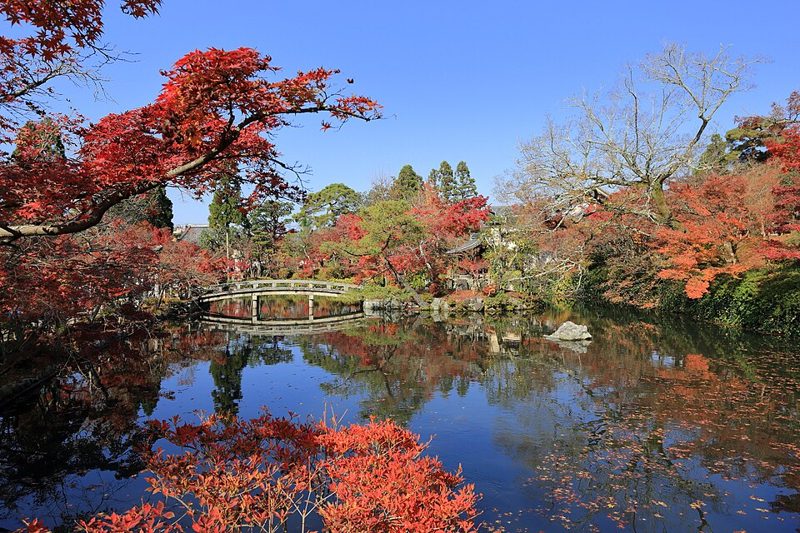
On February 15, 1082, according to temple legend, Amida Buddha stepped down from his altar, walked ahead of the monk Yokan, and turned to look back at him. The remarkable image known as Mikaeri Amida still preserves that backward-looking pose. Eikando's history began in 853, when Shinjo established a temple on this site, and continues through its transformation from Shingon esoteric Buddhism into a center of Pure Land Buddhist teaching.
Kyochika's take
Kyochika recommends approaching Eikando as a temple whose religious history is as compelling as its autumn foliage. Begin with the story of Mikaeri Amida, then explore the garden and accessible halls with that image of compassion in mind.
For autumn 2026, choose between the daytime exhibition, which includes Buddhist artworks, and the separate evening visit, which concentrates on Amida-do and the garden. Kyochika suggests allowing additional time if you want to examine the religious paintings rather than visiting solely for the seasonal scenery.
Hours, admission and access
- Hours
- Ordinary visits: 9:00 AM–4:00 PM reception, gates close at 5:00 PM. Autumn Exhibition 2026: November 11–December 6, 9:00 AM–4:00 PM reception, gates close at 5:00 PM. Night Visit 2026: November 20–December 6, 5:30 PM–8:30 PM reception, gates close at 9:00 PM.
- Closed
- Ordinary visits: open daily except during the Autumn Exhibition, when special visiting arrangements apply. Some temple buildings may close temporarily for ceremonies or religious services. During November 11–December 6, 2026, Garyu-ro and Senbutsu-do are closed. Taho-to Pagoda may close because of crowds or inclement weather.
- Admission
- Ordinary individual admission: adults ¥1,000; university students ¥800; junior/high school students ¥600; elementary school students ¥200. Ordinary group admission for 30 or more: adults ¥800; university students ¥700; junior/high school students ¥500; elementary school students ¥200. Autumn Exhibition 2026 daytime: adults ¥1,500, university students ¥1,000, junior/high school students ¥800; adult groups of 30 or more ¥1,300. Night Visit 2026: junior high school students and above ¥1,000. Daytime and nighttime admission require separate tickets.
- Access
- From Kyoto Station, take Kyoto City Bus Route 5 to Nanzen-ji Eikando-michi, followed by a 3-minute walk. Alternatively, take the Karasuma Subway Line toward Kokusai-kaikan, change at Karasuma Oike to the Tozai Line toward Rokujizo, and get off at Keage Station; the temple is a 15-minute walk away.
- Nearest station
- Keage Station
Checked against official information on 2026-10-28. Details change, so check the official website before you go.
Sources: Eikando Official Introduction, Eikando Official Visitor Information, Eikando Official Access, Eikando Official Chronology, Eikando Official Cultural Heritage, Eikando Official Mikaeri Amida Introduction
 Pochikichi's story corner
How did a Shingon temple become the home of the backward-looking Amida?
Eikando's documented history begins in 853, when Shinjo, a disciple of Kukai, established a temple on the present grounds. The official temple chronology records that Shinjo acquired the land from Fujiwara Sekio in October of that year. In 863, Emperor Seiwa granted the institution the name Zenrin-ji, meaning Temple in a Calm Grove. The establishment was intended as a place of Buddhist training. Shinjo's regulations emphasized the cultivation of people capable of putting Buddhist teachings into practice, giving the early temple an educational and religious purpose that went beyond the construction of buildings.
For its earliest period, Zenrin-ji belonged to the Shingon tradition of esoteric Buddhism. Its later identity was shaped by Yokan, who lived from 1033 to 1111 and is also known as Eikan. The temple's familiar name derives from him. Yokan emphasized devotion to Amida and the recitation of the nembutsu, an expression of faith central to Pure Land Buddhism. His work extended beyond religious observance. The temple records that he established a hospital and planted plum trees whose fruit could be used as medicine for people in need. The trees became associated with the name Hidenbai, preserving the memory of charitable work within the religious grounds.
The transition toward Pure Land Buddhism continued through Johen, a Shingon priest who encountered the writings of Honen, the founder of the Jodo tradition. According to Eikando's official history, Johen came to accept Honen's teachings and recognized him as the temple's eleventh nominal head. Leadership subsequently passed to Shoku, Honen's disciple and the founder of the Seizan branch. Joon, a disciple of Shoku, completed the formal transition of the temple from Shingon Buddhism to the Seizan branch of Jodo Buddhism. These developments fundamentally changed the institution's religious identity while preserving its earlier history.
Eikando was devastated during the Onin War, which began in 1467. Its chronology records rebuilding work from 1472 to 1497, followed by further architectural development. Garyu-ro was built in 1504, the main Miei-do building was erected in 1600, and the present Taho-to Pagoda dates to 1928. These dates show that the temple's historic character emerged through successive periods of restoration and construction rather than through the survival of a single original complex. In the early Meiji period, Buddhist institutions faced new political pressures, and the monk Shungoku contributed to social welfare through a hospital that preceded Kyoto Prefectural Hospital. So when you visit, look for the relationship between the religious images, the buildings from different periods, and the charitable tradition associated with Yokan.
Sources: Eikando Official Introduction, Eikando Official Chronology, Eikando Official Mikaeri Amida Introduction
Long ago, around hereWhat was Eikando like in earlier centuries?
In 853, Shinjo established the institution that became Zenrin-ji on land obtained from Fujiwara Sekio. The following decade brought imperial recognition: Emperor Seiwa gave the temple its name in 863. Shinjo's rules described a place intended to train people in Buddhist practice. The temple initially followed Shingon esoteric Buddhism, so the Pure Land identity familiar to visitors today developed later. During the eleventh century, Yokan introduced a powerful emphasis on Amida devotion and charitable assistance. The official chronology records the establishment of his hospital, Yakuoin, in 1097.
By the early seventeenth century, Zenrin-ji had recovered from its destruction during the Onin War and undergone major rebuilding. The official chronology records Garyu-ro in 1504, the main Miei-do building in 1600, and the transfer of Amida-do from Osaka in 1607. The temple continued to develop through the Edo period and into modern Japan. During the Meiji period, religious reforms affected Buddhist institutions, while clergy such as Shungoku participated in social welfare. The temple's present architectural landscape therefore contains physical evidence of rebuilding, adaptation and changing religious life.
Sources: Eikando Official Chronology, Eikando Official History
Hidden highlights
- Mikaeri Amida
- The principal image stands 77 centimeters tall and dates approximately to the late Heian or early Kamakura period. Its head turns over the shoulder, expressing Amida's willingness to wait for people who have not yet reached the path of faith.
- Garyu-ro
- The official chronology dates the covered corridor to 1504 and describes its name as the Reclining Dragon Passage. The corridor is closed during the November 11–December 6, 2026 Autumn Exhibition.
- Taho-to Pagoda
- The official chronology records the pagoda's construction in 1928. Access may be suspended during the autumn exhibition because of weather or congestion.
- Hidenbai Plum Trees
- Yokan planted plum trees to provide fruit used as medicine for people in need. The story connects the temple's landscape with its history of charitable assistance.
- Descent of the Twenty-five Bodhisattvas
- This religious artwork is listed among the works presented in the 2026 autumn exhibition. It provides a way to explore the visual traditions of Pure Land Buddhism.
- Yamagoshi Amida Painting
- Eikando identifies Yamagoshi Amida Zu, depicting Amida descending over mountains, as a National Treasure. Confirm its display status before visiting rather than assuming the original artwork is permanently exhibited.
Sources: Eikando Official Introduction, Eikando Official Chronology, Eikando Official Cultural Heritage, Eikando Official 2026 Visitor Information
Why does Amida look backward?
Eikando's most famous religious legend takes place on the morning of February 15, 1082. Yokan was walking around an altar while reciting the nembutsu when the image of Amida descended from its platform and began walking ahead of him. The startled monk stopped. According to the temple's detailed account of the legend, Amida looked back and called for Eikan to follow. The monk was so moved by the compassionate gesture that he wished the image to retain its unusual posture.
The temple interprets the backward glance as a symbol of concern for others. Amida waits for those behind, shows mercy to neighbors and continues to care for people who have not yet reached the front. The significance of the sculpture lies not only in its unusual physical pose but also in how that pose communicates a religious teaching without requiring a written explanation. The story should be understood as a temple legend rather than a historically verified supernatural event.
The monk who turned faith into medical care
Yokan's contribution to Zenrin-ji included a form of practical charity. The temple's official chronology records that he established Yakuoin, a hospital within the grounds, in 1097. Its historical introduction also explains that he cultivated plums whose fruit could be given to people in need as medicine. This activity became part of the institution's remembered identity.
The connection between religious training and assistance to the poor is an important counterpoint to Eikando's celebrated Buddhist artworks. Yokan is remembered both for the vision associated with Mikaeri Amida and for responding to human suffering through material help. The tradition offers a different perspective on the purpose of a medieval Buddhist institution.
Sources: Eikando Official History, Eikando Official Chronology
How to walk it
- Entrance — Begin with the entrance and follow the route permitted for the day's visiting arrangements. (5 min)
- Temple halls — Explore the accessible religious buildings and observe their relationship to the garden. (15 min)
- Mikaeri Amida — Look for the principal image's backward-looking posture and consider the temple's explanation of its meaning. (10 min)
- Garden — Follow the designated garden route and examine the seasonal planting. (15 min)
- Taho-to Pagoda — Visit the pagoda if access is permitted. The official chronology dates it to 1928. (15 min)
- Autumn exhibition — If visiting during the exhibition, spend additional time with the displayed Pure Land Buddhist artworks. (20 min)
All durations are Kyochika estimates, not official walking times. The suggested full daytime visit takes approximately 80 minutes. During the autumn exhibition, Garyu-ro and Senbutsu-do are closed, and Taho-to may be inaccessible. The nighttime visitor area is limited to Amida-do and the garden, so the full daytime route does not apply after dark.
Sources: Eikando Official Visitor Information, Eikando Official Chronology
Through the seasons
- Spring
- Explore the temple buildings and garden during ordinary visiting hours.
- Summer
- Visit the religious halls and garden, checking for any temporary building closures.
- Late November
- Eikando's official history identifies late November as a period when visitors come to enjoy the maple foliage.
- November 11–December 6, 2026
- The Autumn Exhibition presents Buddhist artworks associated with Pure Land teachings.
- November 20–December 6, 2026
- The official visitor guide schedules nighttime admission to Amida-do and the garden.
- Winter
- Explore the religious history and temple architecture under the ordinary visiting arrangements.
Getting there by taxi or bus
- Taxi
- The temple's official autumn visitor information states that private-car parking is unavailable during the exhibition. Public transportation is recommended.
- Bus
- Kyoto City Bus Route 5 to Nanzen-ji Eikando-michi (南禅寺・永観堂道), followed by a 3-minute walk. Routes 204 or 93 to Higashi Tenno-cho (東天王町), followed by an 8-minute walk.
- Other
- From Kyoto Station, take the Karasuma Subway Line and change at Karasuma Oike to the Tozai Line toward Rokujizo. Get off at Keage Station and walk approximately 15 minutes.
Sources: Eikando Official Access, Eikando Official Visitor Information
Pair it with
- Nanzen-ji Temple — The official Eikando chronology records that the former imperial villa Zenrinji-den became Nanzen-ji in 1291, making the neighboring institution relevant to Eikando's own history. (5 min walk)
- Philosopher's Path — Consider extending the visit with a walking route through eastern Kyoto. (10 min walk)
- Ginkaku-ji Temple — Consider combining Eikando with another eastern Kyoto Buddhist destination. (40 min walk)
Good to know before you go
- An official English-language visitor guide and downloadable brochure are available.
- The temple provides an etiquette video in English.
- Tickets for the 2026 autumn daytime and nighttime visits are sold on the day; advance tickets are not available.
- Daytime visitors must leave the temple grounds by 5:00 PM before the nighttime visit.
- The temple requests that visitors bring their own shoe bags during the autumn exhibition.
- Photography and video are prohibited inside temple buildings except where garden photography is permitted.
- Tripods and similar photographic equipment are prohibited within the precincts.
- Selfie sticks are prohibited inside temple buildings.
- Pets are not permitted within the precincts.
- Eating, drinking and smoking are prohibited within the precincts.
- Baby strollers are not permitted on interior temple walkways during the autumn exhibition.
- Private cars, motorcycles and e-scooters cannot use temple parking during the autumn exhibition.
- A pre-written goshuin is available for ¥500 during the nighttime illumination.
- The temple may close some buildings for ceremonies or religious services.
Next stop: book for later today PR
Tickets and experiences in Kyoto you can book on Klook. Filter by “Today” to see what is still open.
Kimono rental in Kyoto→Tea ceremony experiences in Kyoto→Kyoto one-day sightseeing tours→All things to do in Kyoto on Klook →Compare on GetYourGuide: Kimono rental in Kyoto · Tea ceremony experiences in Kyoto · Kyoto one-day sightseeing tours
Ad: Klook and GetYourGuide affiliate links.
🍜 Where to eat after
Restaurants near here on Google Maps→Many restaurants in Kyoto take reservations, and some are cash only. Check the restaurant page before you go.
Events nearby
Art exhibition
Sumitomo Shunsui 100th Memorial Special Exhibition: The Sumitomo Collection of Modern Art at Sen-oku Hakukokan Museum
Sen-oku Hakukokan Museum (Kyoto, Shishigatani) (Keage Sta.)
Oct 31 (Sat) – Dec 20 (Sun) Last entry 16:30. Closed Mondays (open November 23, closed November 24)
Marking 100 years since the death of Sumitomo Tomoito (Shunsui), the 15th head of the Sumitomo family, the exhibition shows the modern paintings and crafts he collected, including Claude Monet's Parc Monceau and Itaya Hazan's Important Cultural Property porcelain vase.
Details →Festival & seasonal event
Eikando Autumn Illumination and Special Night Viewing
Eikando Temple (Zenrin-ji) (Keage Sta.)
Nov 20 (Fri) – Dec 6 (Sun) 17:30 – 21:00
Enjoy around 3,000 maple trees glowing with autumn colors around a traditional strolling pond garden. Last admission at 8:30 PM; lights out and gates close at 9:00 PM.
Details →Nov 14 (Sat) – Nov 23 (Mon) 17:30 – 21:30
Murin-an, the former villa of statesman Yamagata Aritomo, opens at night only during the autumn leaf season. Each session includes a short talk by a garden concierge, a stroll through the illuminated garden, and cafe service with matcha or sparkling wine and original sweets. Two sessions (17:30 and 19:30) with 30 places each, booking required on a first-come basis. A day runs only if at least 14 people book. No parking.
Details →Festival & seasonal event
Autumn Special Opening: Night Viewing at Kurodani Konkai Komyo-ji
Kurodani Konkai Komyo-ji Temple (Keage Sta.)
Nov 13 (Fri) – Dec 6 (Sun) 17:30 – 20:30
Maples reflected in the pond of the Shiun Garden, with the main hall, gate, bell tower and approach lit up. Live koto and shinobue performances three times each night. Last entry 8:00 PM.
Details →Nov 6 (Fri) 10:00 – 16:00
Scheduled market dates during the featured period are November 6 and December 4, not every day. Up to around 160 stalls gather against the backdrop of Heian Jingu Shrine. Held even in rainy weather.
Details →Dec 4 (Fri) 10:00 – 16:00
Scheduled market dates during the featured period are November 6 and December 4, not every day. Up to around 160 stalls gather against the backdrop of Heian Jingu Shrine. Held even in rainy weather.
Details →
Tips from visitors
Been here? Leave a short tip for the next traveler — in any language. No name, no sign-up.
Thank you! We check every tip by hand and post it within a day or two.
How we post tips: we read every one before it goes up. We remove swear words, insults, ads, links and anything that could identify a person. Tips are shown in the language they were written in, with a translate link. Kyochika never writes or pays for tips, and there are no star ratings.
FAQ
- What is Eikando (Zenrin-ji Temple)?
- On February 15, 1082, according to temple legend, Amida Buddha stepped down from his altar, walked ahead of the monk Yokan, and turned to look back at him. The remarkable image known as Mikaeri Amida still preserves that backward-looking pose. Eikando's history began in 853, when Shinjo established a temple on this site, and continues through its transformation from Shingon esoteric Buddhism into a center of Pure Land Buddhist teaching.
- Hours at Eikando (Zenrin-ji Temple)?
- Ordinary visits: 9:00 AM–4:00 PM reception, gates close at 5:00 PM. Autumn Exhibition 2026: November 11–December 6, 9:00 AM–4:00 PM reception, gates close at 5:00 PM. Night Visit 2026: November 20–December 6, 5:30 PM–8:30 PM reception, gates close at 9:00 PM.
- Closed at Eikando (Zenrin-ji Temple)?
- Ordinary visits: open daily except during the Autumn Exhibition, when special visiting arrangements apply. Some temple buildings may close temporarily for ceremonies or religious services. During November 11–December 6, 2026, Garyu-ro and Senbutsu-do are closed. Taho-to Pagoda may close because of crowds or inclement weather.
- Admission at Eikando (Zenrin-ji Temple)?
- Ordinary individual admission: adults ¥1,000; university students ¥800; junior/high school students ¥600; elementary school students ¥200. Ordinary group admission for 30 or more: adults ¥800; university students ¥700; junior/high school students ¥500; elementary school students ¥200. Autumn Exhibition 2026 daytime: adults ¥1,500, university students ¥1,000, junior/high school students ¥800; adult groups of 30 or more ¥1,300. Night Visit 2026: junior high school students and above ¥1,000. Daytime and nighttime admission require separate tickets.
- Access at Eikando (Zenrin-ji Temple)?
- From Kyoto Station, take Kyoto City Bus Route 5 to Nanzen-ji Eikando-michi, followed by a 3-minute walk. Alternatively, take the Karasuma Subway Line toward Kokusai-kaikan, change at Karasuma Oike to the Tozai Line toward Rokujizo, and get off at Keage Station; the temple is a 15-minute walk away.
- When is Eikando's autumn foliage season?
- The temple's official introduction identifies late November as an important time for viewing its maple leaves. Actual foliage conditions depend on the season.
- Can I stay inside for the evening illumination?
- No. The official 2026 visitor guide requires daytime visitors to leave by 5:00 PM. Nighttime admission is separate.
- Can I photograph Mikaeri Amida?
- The temple prohibits photography and video inside temple buildings, except for permitted garden photography.
- Will the Garyu-ro corridor be open in autumn 2026?
- No. Eikando officially states that Garyu-ro will be closed from November 11 through December 6, 2026.