Tsukiji Outer Market Audio Guide – Self-Guided Tour in English
Stand where it happened, and hear the story
The answers are in the audio guide, told at the spot where each one happened.
- 1657How did a devastating fire lead to the creation of the land beneath today's Tsukiji market?
- 1659When waves kept destroying Tsukiji's new embankments, what mysterious discovery supposedly allowed the work to continue?
- 1848–1923How did one pair of wooden lion heads survive the disaster that destroyed so many others?
- 1899–2018How did a beef bowl shop serving fish market workers become connected to a famous eating style?
- 1934Why does this Buddhist temple look like an ancient Indian building outside but distinctly Japanese inside?
10 tracks in walking order. Press play at each stop.
Tsukiji Outer Market is a food district of around 460 shops near Ginza that stayed in Tsukiji when the inner market moved to Toyosu in 2018. Walk from Namiyoke-dori to Tsukiji Hongwanji with this self-guided English audio guide in your earphones (first track free, full tour with a US$3 7-day pass): stories, legends and things to look for at each stop.
About this Tsukiji Outer Market audio guide
10 short tracks, about 6 minutes of listening in total. Plan roughly 36–66 minutes on site if you stop at each spot (our estimate). Play a track when you reach each stop, then tap Next. The first track is free; a 7-day pass for $3 unlocks every track of every Kyochika audio guide in Tokyo, Kamakura and Kyoto. The full transcript further down this page is free to read.
The route, stop by stop
- Welcome
- Land built on the sea
- Tamagoyaki on Namiyoke-dori
- The god who stopped the waves
- Lion heads and rain basins
- Tsukiji Uogashi
- The Higashi-dori alleys
- A beef bowl story
- Tsukiji Hongwanji
- Goodbye
What you will hear
- Welcome – This food district has around four hundred and sixty shops, and it is free to walk in. Shops open at about eight in the morning and close around two in the afternoon, but many serve trade buyers until nine, so after nine is best for visitors.
- Land built on the sea – Tsukiji means built land. The name is said to come from land reclaimed from the sea after the Great Meireki Fire of 1657, to rebuild Hongwanji temple.
- Tamagoyaki on Namiyoke-dori – Now walk along Namiyoke-dori. Here you'll find Tsukiji Yamachou, a rolled omelet shop founded in 1949.
- The god who stopped the waves – This is Namiyoke Inari Shrine, at the southern edge of the outer market. It is said to date from 1659.
- Lion heads and rain basins – Two hidden treasures here. Inside the main hall is a pair of wooden lion heads, male and female, made in 1848.
- Tsukiji Uogashi – Chun again! Back on Namiyoke-dori, step into the Kaikobashi building of Tsukiji Uogashi, built by Chuo City.
- The Higashi-dori alleys – Kasuke here. Deep in a narrow alley is Kumade-ya Yamanoi Shoten, a shop that chefs come to for their tools.
- A beef bowl story – Chun with a tasty story! Yoshinoya, the beef bowl chain, began in 1899 at the Nihonbashi fish market, feeding market workers.
- Tsukiji Hongwanji – Last stop, right next to the outer market: Tsukiji Hongwanji. Does it look like India to you?
- Goodbye – That's the end of the Tsukiji guide. Thanks for walking with us!
Tsukiji Outer Market audio guideFor earphones, as you walk (10 tracks)
 PochikaYour guide around Tokyo
 Sagi-senseiTemples, gardens and history
 ChunOld town, shops and festivals
 KasukeHidden spots and surprises
The first track of every guide is free.
The first track is free. Unlock every track of every Kyochika audio guide in Tokyo and Kyoto (English and Chinese) for 7 days for $3. The scripts below stay free to read.
$3 · 1 phone, 7 days →$8 · Family, up to 4 phones →Pay by card (Stripe). Each pass works on the phone and browser it is opened on. With the family pass you get a link and a QR code to add 3 more phones. Legal notice (Japanese)
Keeps playing with the screen off. It stops after each spot: when you arrive at the next one, tap “Next” or ▶▶ on your lock screen. Voices: Kokoro (open-source text-to-speech)
Where a local ramen cook eats in Tsukiji
Picks from Hige of "Hige to Yamamoto" (about 348K followers on TikTok), who runs MAZE TOKYO in the outer market.
- Kōken (幸軒): old-school shoyu ramen and jumbo shumai
- Chōju-an (長寿庵): soba with a mini seafood bowl set
- Kaki to Kai (牡蠣と貝): rich ramen made with plenty of oysters
- His own shop MAZE TOKYO: mazesoba and wagyu rice bowls, 7:00–15:00. Enter through Kasagawa Suisan and take the stairs at the back left.
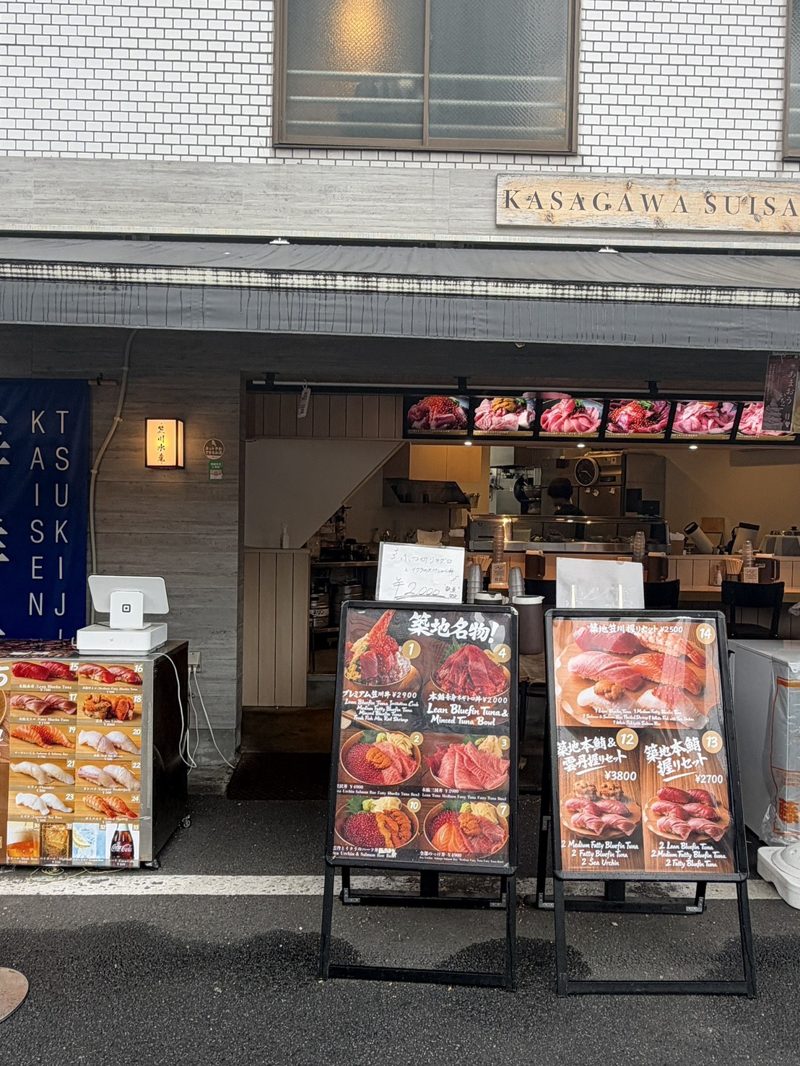 The way in to MAZE TOKYO (photo by Kyochika, 17 Nov 2026)
His tip: go in the morning; midday is next best.
Hige’s full Tsukiji page →🍜 Where to eat after
Top-rated restaurants in Tsukiji (Tabelog, sorted by rating)→Restaurants near here on Google Maps→Many restaurants in Japan take reservations, and some are cash only. Check the restaurant page before you go.
Next stop: book for later today PR
Tickets people often book around here, on Klook.
Year-end deal: extra 5% off selected Tokyo attractions on Klook with code TOKYOATT5% (until Dec 31).
Tsukiji food and walking tour→teamLab Planets TOKYO ticket→Advertisement
Visiting info
| Hours | About 8:00–14:00 (varies by shop). Many shops serve trade buyers until 9:00, so general visitors are advised to come after 9:00 |
|---|---|
| Closed | In principle Sundays, national holidays and some Wednesdays. Many shops follow the Tokyo Central Wholesale Market calendar (varies by shop) |
| Admission | Free |
| Payment | Many shops are cash only. Card acceptance varies by shop |
| Address | 4-16-2 Tsukiji, Chuo-ku, Tokyo (Plat Tsukiji information center) |
| Getting there | About 1 min walk from Tsukijishijo Station (Oedo Line) Exit A1, or 1–3 min from Tsukiji Station (Hibiya Line) Exits 1 and 2. Also walkable from Higashi-ginza Station. About 10 min on foot from Ginza and Shiodome |
Checked on 2026-10-27 against the official pages. Hours can change; please check the official page before you go.
Transcript
1. Welcome (Pochika)
Welcome to Tsukiji Outer Market! I'm Pochika, your guide. This food district has around four hundred and sixty shops, and it is free to walk in. Shops open at about eight in the morning and close around two in the afternoon, but many serve trade buyers until nine, so after nine is best for visitors. It is closed in principle on Sundays, national holidays and some Wednesdays. Many shops take cash only, so bring small change. We start at Plat Tsukiji, the information center, about one minute from Tsukijishijo Station Exit A1. Grab a map here!
2. Land built on the sea (Sagi-sensei)
I'm Sagi-sensei. Tsukiji means built land. The name is said to come from land reclaimed from the sea after the Great Meireki Fire of 1657, to rebuild Hongwanji temple. Tokyo's fish market is said to have started at the foot of Nihonbashi bridge in the early Edo period. The Great Kanto Earthquake of 1923 devastated it, and in 1935 it reopened here as the Tsukiji Central Wholesale Market. Shops for food and kitchen tools gathered around it, and that became the outer market. In October 2018 the inner market moved to Toyosu after eighty-three years. But the outer market stayed right here.
3. Tamagoyaki on Namiyoke-dori (Chun)
Hi, I'm Chun! Now walk along Namiyoke-dori. Here you'll find Tsukiji Yamachou, a rolled omelet shop founded in 1949. Get a fresh tamagoyaki on a stick! One rule to remember: eating while walking is not allowed. Eat in front of the shop or in a designated area. The alleys are narrow, so keep your group small. Now follow the street to its end, where a shrine is waiting.
4. The god who stopped the waves (Sagi-sensei)
This is Namiyoke Inari Shrine, at the southern edge of the outer market. It is said to date from 1659. When this stretch of sea was being filled in, the waves kept washing the embankments away. The story goes that people found a sacred image of the Inari deity floating in the sea and enshrined it. At once, the wind and the waves stopped, and the work could be finished. Namiyoke means warding off waves. It became the guardian shrine of Tsukiji, and no wonder so many market people pray here.
5. Lion heads and rain basins (Kasuke)
Hey, I'm Kasuke. Two hidden treasures here. Inside the main hall is a pair of wooden lion heads, male and female, made in 1848. Many lion heads burned in the great earthquake of 1923, and this pair alone survived. Every June, the shrine holds the Tsukiji Shishi Matsuri, with giant heads of a dragon, a tiger and a lion. Now look in front of the shrine for two cast iron rainwater basins, seventy centimeters tall. They were donated in 1838 by porters who unloaded cargo at the Owari Tokugawa clan warehouse.
6. Tsukiji Uogashi (Chun)
Chun again! Back on Namiyoke-dori, step into the Kaikobashi building of Tsukiji Uogashi, built by Chuo City. Go up to the third floor. There's the Uogashi Shokudo food court and a rooftop plaza, a nice place for lunch or a break. On the third floor you can cross over to the second building, Odawarabashi, on Harumi-dori. Just remember, no eating while walking on the first floor.
7. The Higashi-dori alleys (Kasuke)
Kasuke here. Welcome to the Higashi-dori alleys, full of kitchen tool and tuna shops. Deep in a narrow alley is Kumade-ya Yamanoi Shoten, a shop that chefs come to for their tools. Bamboo sushi mats and matcha utensils are popular with visitors from overseas. Here's some trivia. The former market site next door is said to have held the second home of Matsudaira Sadanobu, the senior councillor who led the Kansei Reforms. Now it is being redeveloped, with plans for a venue holding about fifty thousand people.
8. A beef bowl story (Chun)
Chun with a tasty story! Yoshinoya, the beef bowl chain, began in 1899 at the Nihonbashi fish market, feeding market workers. When the market moved to Tsukiji, Yoshinoya moved too. The shop rebuilt here in 1947 is regarded as its first store. The tsuyudaku style, with extra sauce, is said to have started with workers who wanted to eat fast. That Tsukiji shop closed on October 6, 2018, when the market moved to Toyosu.
9. Tsukiji Hongwanji (Kasuke)
Last stop, right next to the outer market: Tsukiji Hongwanji. Does it look like India to you? The main hall was rebuilt in 1934 after the great earthquake, designed by the architect Ito Chuta. It is made of reinforced concrete. The outside borrows from ancient Indian Buddhist buildings, and the inside follows traditional Japanese design. In 2014 it became a national Important Cultural Property. Step inside and look for the chandelier and the German-made pipe organ.
10. Goodbye (Pochika)
That's the end of the Tsukiji guide. Thanks for walking with us! If you still have time, Hama-rikyu Gardens are close by. Our suggestion: breakfast at the market, then a walk around the tidal pond garden. Ginza is also about ten minutes on foot. Check Kyochika for events near your next stop. See you again!
Tips from visitors
Been here? Leave a short tip for the next traveler — in any language. No name, no sign-up.
Thank you! We check every tip by hand and post it within a day or two.
How we post tips: we read every one before it goes up. We remove swear words, insults, ads, links and anything that could identify a person. Tips are shown in the language they were written in, with a translate link. Kyochika never writes or pays for tips, and there are no star ratings.
FAQ
Is the audio guide free?
The first track of every guide is free, with no app and no sign-up. A 7-day pass for $3 unlocks every track of every guide. The scripts are always free to read.
Do I need a reservation?
Free
Where does the tour start?
At Plat Tsukiji information center, about 1 minute from Tsukijishijo Station Exit A1. The tracks follow the walk along Namiyoke-dori to Namiyoke Inari Shrine, Tsukiji Uogashi, the Higashi-dori alleys and Tsukiji Hongwanji. Each track stops at the end, so tap “Next” when you reach the next spot.
When is it closed?
In principle Sundays, national holidays and some Wednesdays. Many shops follow the Tokyo Central Wholesale Market calendar (varies by shop)
Sources
- GO TOKYO「築地場外市場」 (Japanese)
- Good Luck Trip「築地場外市場」 (Japanese)
- GO TOKYO「築地」 (Japanese)
- 野村不動産ソリューションズ「まちから」築地 (Japanese)
- 中央区「中央卸売市場築地市場」(区の展示資料) (Japanese)
- 法政大学 江戸東京研究センター 資料(築地の年表) (Japanese)
- nippon.com「築地場外市場」 (Japanese)
- さんたつ by 散歩の達人「築地の波除神社で『つきじ獅子祭』」 (Japanese)
- 中央区「波除稲荷神社の天水鉢」 (Japanese)
- 中央区「波除稲荷神社の獅子頭」 (Japanese)
- 中央区「築地魚河岸」 (Japanese)
- GO TOKYO「Tsukiji Outer Market」
- ASCII.jp「吉野家の一号店」 (Japanese)
- 文化遺産オンライン「築地本願寺本堂」 (Japanese)
All 48 English audio guides in Tokyo & Kyoto →
Nearby guides
- Hama-rikyu Gardens audio guide (0.9 km · 11 tracks)
- Zojoji Temple and Tokyo Tower audio guide (2.2 km · 10 tracks)
- East Gardens of the Imperial Palace audio guide (2.7 km · 12 tracks)
- Ueno Park audio guide (5.5 km · 10 tracks)
- Shinjuku Gyoen National Garden audio guide (5.9 km · 11 tracks)