Kimono & textiles in Kyoto · Saga-Arashiyama and Hozu Gorge, Kyoto–Kameoka
Sagano Romantic Train
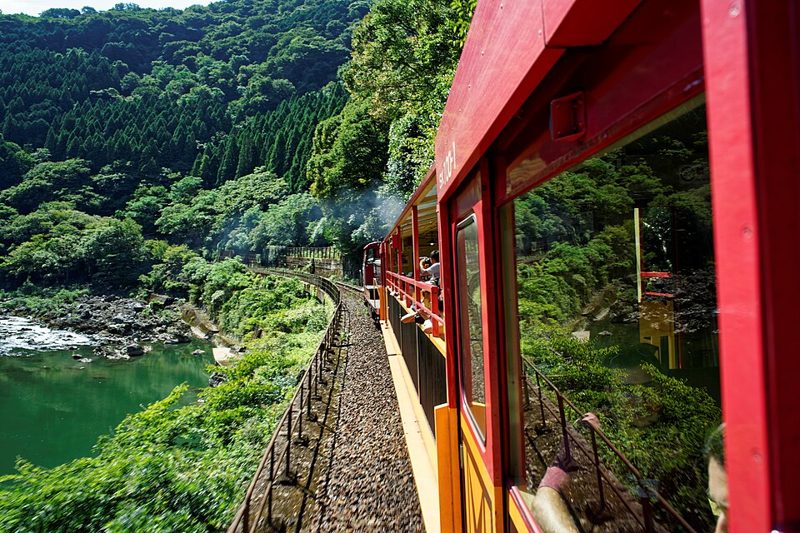
Sagano Scenic Railway began in 1990 with just nine people, using tracks made redundant by the double-tracking of the JR Sanin Line. Today its sightseeing train travels 7.3 kilometers between Torokko Saga and Torokko Kameoka, offering approximately 25 minutes of views across the Hozu River gorge. The present diesel-hauled train includes a windowless fifth carriage called the Rich Car, while the railway's historic bridges and tunnels received national cultural-property recognition in February 2026.
Kyochika's take
Kyochika recommends the Sagano Romantic Train to travelers who want to experience the Hozu gorge as a journey rather than as a distant viewpoint. It is especially suitable for families, railway enthusiasts, photographers, and visitors interested in the relationship between transport heritage and Kyoto's natural landscapes.
Consider choosing a daytime service for views of the river and mountains, or a designated illuminated service for the seasonal evening experience. The fifth carriage offers direct exposure to wind and outdoor conditions, so it is better suited to passengers comfortable with changing weather.
Reserve the train before arranging the rest of your Arashiyama itinerary. This is particularly useful when planning to visit station exhibits or when connecting onward from Torokko Kameoka.
Hours, admission and access
- Hours
- 2026 operating period: March 1–December 29. Kyoto City lists 9:02 AM–4:02 PM as the regular service window, with additional trains depending on the day and season. Individual departures must be checked against the operator's timetable.
- Closed
- Service operates according to the official railway calendar. Non-operating days and special departures must be checked for the travel date.
- Admission
- One-way fare: adults 880 yen; children 440 yen, according to Kyoto City's official 2026 tourism listing. The operator's currently retrieved ordinary-fare table did not display numerical fare amounts, so the final payable fare should be checked during booking.
- Access
- Torokko Saga Station is immediately adjacent to JR Saga-Arashiyama Station, according to Kyoto City's official tourism guide.
- Nearest station
- JR Saga-Arashiyama Station
Checked against official information on 2026-10-28. Details change, so check the official website before you go.
Sources: Sagano Scenic Railway — Official Website, Sagano Scenic Railway — Official Overview and History, Sagano Scenic Railway — Fares and Tickets, Sagano Scenic Railway — Operating Schedule, Sagano Scenic Railway — Stations, Sagano Scenic Railway — Frequently Asked Questions, Kyoto City Official Tourism Guide — Sagano Romantic Train 2026, Kyoto City — Fantasy Train of Lights and Railway Heritage, September 2026
 Pochikichi's story corner
How did a disused railway line become one of Kyoto's scenic journeys?
The Sagano Romantic Train grew from a change in the way trains traveled through western Kyoto. When the JR Sanin Line was double-tracked, part of its older railway alignment was no longer required for ordinary passenger operations. The abandoned section followed the Hozu River gorge, where the railway passed between wooded mountainsides, tunnels, and bridges. Rather than losing the route completely, a new organization began developing it for tourism. Sagano Scenic Railway was established in 1990 with a staff of just nine people, including its president.
The idea was to give the former railway a different purpose. Ordinary railway services are generally designed to move passengers efficiently between destinations; here, the route and its scenery became the central attraction. The company developed an experience based on slower travel, traditional-looking carriages, and the changing landscape along the river. Kyoto City's 2026 feature records that the new venture initially faced doubts about its prospects. Its success demonstrated that a railway could become a destination through the experience of traveling rather than through speed or convenience.
The current train combines a diesel locomotive and converted passenger vehicles. Kyoto City's September 2026 feature identifies the locomotive as a DE10 type manufactured in 1971 and describes the carriages as converted freight vehicles. The operator describes Art Deco-style interiors with wooden seats and exposed light bulbs. Carriage 5, the Rich Car, is particularly distinctive because it has no conventional glass windows. Passengers feel the moving air and hear the sounds of the gorge directly, although they are also exposed to rain.
The railway's infrastructure has gained recognition in its own right. Kyoto City's official feature reports that 18 civil-engineering structures, including bridges and tunnels, were registered as national Tangible Cultural Properties in February 2026. Many date from the Meiji period and remain part of the operating railway. The same 2026 feature states that the present carriages are scheduled to retire at the end of the year before replacement by new rolling stock. So when you visit, look beyond the mountains and river: the bridges, tunnels, locomotive, and carriages reveal how an older transport route has acquired a second life as a sightseeing railway.
Sources: Sagano Scenic Railway — Official Overview and History, Kyoto City — Fantasy Train of Lights and Railway History, September 2026
Long ago, around hereWhat was the Hozu gorge before the sightseeing railway?
The present train route occupies a landscape shaped by the Hozu River and the surrounding mountains. Its modern sightseeing role began only after railway improvements made the original Sanin Line alignment unnecessary for ordinary service. The official railway history does not provide sufficient information to reconstruct the exact structures or settlements occupying the line's location approximately 1,200 or 400 years ago. What can be confirmed is that the railway now follows a river gorge whose scenery is the central reason for the sightseeing service.
The more securely documented historical layer is the railway infrastructure itself. Kyoto City's 2026 account identifies bridges and tunnels from the Meiji period among the structures that received national cultural-property recognition. These structures demonstrate the engineering effort involved in creating a railway through the gorge. After the original route lost its regular transport role, Sagano Scenic Railway began adapting it for sightseeing in 1990. The result is a landscape in which historic railway engineering and contemporary tourism occupy the same route.
Sources: Sagano Scenic Railway — Official History, Kyoto City — Railway Heritage Feature
Hidden highlights
- Rich Car
- Carriage 5 is the train's open-sided vehicle, without conventional glass windows. The operator warns that wind enters directly and that rain may reach passengers.
- The DE10 Locomotive
- Kyoto City's 2026 feature identifies the diesel locomotive as a DE10 type manufactured in 1971. Its appearance is an important part of the train's retro character.
- Historic Railway Structures
- The route includes bridges and tunnels belonging to a group of 18 civil-engineering structures nationally registered as Tangible Cultural Properties in February 2026.
- 19th Century Hall
- Torokko Saga Station includes an exhibition area featuring four steam locomotives and musical instruments, including pianos, according to Kyoto City's 2026 feature.
- Diorama Kyoto JAPAN
- The Torokko Saga Station complex includes a large railway diorama. Railway enthusiasts may wish to explore it alongside the actual train journey.
- Multilingual Audio Guide
- Kyoto City's 2026 feature describes a free smartphone guide in Japanese, English, Chinese, and Korean, with audio linked to the train's location.
Sources: Sagano Scenic Railway — Official Overview, Sagano Scenic Railway — Frequently Asked Questions, Kyoto City — 2026 Railway and Illumination Feature
The railway that began with nine people
Sagano Scenic Railway's official history records an unusual beginning. In 1990, a team of nine people, including the company's president, began developing a tourism service using tracks no longer needed after the double-tracking of the JR Sanin Line. Kyoto City's account adds that the project was initially greeted with skepticism about whether it could survive.
The route's appeal came from a combination of scenery and railway character. The company's historical account emphasizes customer service, while the 2026 Kyoto City feature describes how views through the gorge and the distinctive carriages contributed to the railway's success. It is a story of infrastructure finding a new purpose: a line no longer required for the same transport function could continue to carry passengers because the journey itself had become valuable.
Sources: Sagano Scenic Railway — Official History, Kyoto City — Railway History Feature
How did the Hozu gorge become an illuminated railway landscape?
The railway's illuminated sightseeing program began in 2005, according to Kyoto City's September 2026 feature. Known as the Fantasy Train of Lights, the experience uses lighting installations along the line to reveal river scenery, mountainsides, autumn foliage, and selected railway structures after dark. The city reports approximately 1,000 lighting units illuminating parts of the gorge.
The illuminated landscape differs fundamentally from the normal daytime journey. Instead of following a continuous view of the river and wooded mountains, passengers encounter selected sections picked out by lighting. Kyoto City's feature also notes that some tunnels and railway bridges are illuminated, connecting the scenic experience with the line's newly recognized engineering heritage. Kyochika recommends checking the official operating calendar before planning an evening visit, since special services depend on the date.
Sources: Kyoto City — Fantasy Train of Lights, September 2026, Sagano Scenic Railway — Official Operating Schedule
How to walk it
- JR Saga-Arashiyama Station — Make your way to the adjacent Torokko Saga Station, the starting point of the sightseeing train. (3 min min)
- Torokko Saga Station — Confirm the departure, ticket information, and assigned seat before boarding. (10 min min)
- 19th Century Hall — If accessible before your departure, examine the steam locomotive and musical instrument displays. (15 min min)
- Diorama Kyoto JAPAN — Consider visiting the station's miniature railway display before returning to the boarding area. (15 min min)
- Board the Sagano Romantic Train — Find your carriage and assigned seat and prepare for the journey through the gorge. (5 min min)
- Hozu River gorge — Observe the river, mountainsides, railway bridges, and tunnels during the scenic journey. (25 min min)
- Torokko Kameoka Station — Disembark and follow the station's official directions for your onward journey. (10 min min)
The approximately 25-minute end-to-end train journey is confirmed by Sagano Scenic Railway and Kyoto City. The other durations are Kyochika estimates. Exhibition admission, opening arrangements, and train boarding times must be checked separately. This itinerary combines station walking with a train journey rather than describing a continuous walking route.
Sources: Sagano Scenic Railway — Official Overview, Kyoto City — Sagano Romantic Train 2026, Kyoto City — Railway and Station Exhibitions
Through the seasons
- Spring
- The railway's official seasonal description highlights cherry blossoms along the gorge.
- Summer
- Fresh green foliage becomes a principal feature of the mountainsides. Kyochika suggests a daytime departure for observing the changing vegetation.
- Autumn
- The railway is known for views of autumn leaves along the Hozu River gorge. Special illumination programs add another way to experience the scenery.
- Late autumn and early winter
- Selected illuminated services reveal sections of the gorge, bridges, and tunnels after dark. Confirm specific operating dates.
- Winter
- The railway's official description mentions bare winter scenery and occasional snow. The 2026 operating period ends on December 29, so seasonal views depend on operating dates and weather.
Getting there by taxi or bus
- Taxi
- Request Torokko Saga Station beside JR Saga-Arashiyama Station. If traveling from the Kameoka end, specify Torokko Kameoka Station, not JR Kameoka Station.
- Bus
- No specific bus route and stop combination was confirmed in the opened official access information.
- Other
- Torokko Saga Station is immediately adjacent to JR Saga-Arashiyama Station. The operator confirms that walking between Torokko Saga and Torokko Arashiyama stations takes approximately 20 minutes.
Sources: Kyoto City — Sagano Romantic Train, Sagano Scenic Railway — Frequently Asked Questions
Pair it with
- 19th Century Hall — Explore the steam locomotive and musical instrument displays described in Kyoto City's official feature. (Within the Torokko Saga Station complex min walk)
- Diorama Kyoto JAPAN — Combine the actual train journey with the large miniature railway exhibit at Torokko Saga Station. (Within the Torokko Saga Station complex min walk)
- JR Saga-Arashiyama Station — Use this immediately adjacent station as the principal rail connection when planning the sightseeing journey. (Immediately adjacent, official Kyoto City information min walk)
Good to know before you go
- Kyoto City's 2026 listing gives the operating season as March 1–December 29.
- The published regular service window is 9:02 AM–4:02 PM, with additional trains on selected days or seasons.
- Advance tickets go on sale one month before travel at midnight Japan time, according to the operator's FAQ.
- A limited number of same-day tickets are available at designated stations, subject to availability.
- Torokko Hozukyo Station does not sell same-day tickets.
- The operator publishes ordinary ticket-window opening times of approximately 8:35 AM at Torokko Saga, 8:50 AM at Torokko Arashiyama, and 9:10 AM at Torokko Kameoka.
- During busy periods, the operator states that all three ticket windows may open at approximately 8:35 AM.
- The journey between Torokko Saga and Torokko Arashiyama stations takes approximately 20 minutes on foot, according to the operator's FAQ.
- Torokko Arashiyama Station has 60 steps between the ticket gate and platform and no elevator.
- The train has five carriages, with carriage 5 designated as the Rich Car.
- The Rich Car has no glass windows, and passengers may be exposed to wind and rain.
- Umbrellas are prohibited inside the Rich Car.
- The operator's online purchase instructions allow passengers to select available seats.
- The operator's online booking instructions specify credit-card payment.
- The official website offers an English-language interface.
- Kyoto City's 2026 feature describes a free smartphone audio guide in Japanese, English, Chinese, and Korean.
- The official sources consulted do not establish a universal policy governing all onboard photography or luggage sizes. Follow the operator's published instructions and station staff directions.
Next stop: book for later today PR
Tickets and experiences in Kyoto you can book on Klook. Filter by “Today” to see what is still open.
Kimono rental in Kyoto→Tea ceremony experiences in Kyoto→Kyoto one-day sightseeing tours→All things to do in Kyoto on Klook →Compare on GetYourGuide: Kimono rental in Kyoto · Tea ceremony experiences in Kyoto · Kyoto one-day sightseeing tours
Ad: Klook and GetYourGuide affiliate links.
Tips from visitors
Been here? Leave a short tip for the next traveler — in any language. No name, no sign-up.
Thank you! We check every tip by hand and post it within a day or two.
How we post tips: we read every one before it goes up. We remove swear words, insults, ads, links and anything that could identify a person. Tips are shown in the language they were written in, with a translate link. Kyochika never writes or pays for tips, and there are no star ratings.
FAQ
- What is Sagano Romantic Train?
- Sagano Scenic Railway began in 1990 with just nine people, using tracks made redundant by the double-tracking of the JR Sanin Line. Today its sightseeing train travels 7.3 kilometers between Torokko Saga and Torokko Kameoka, offering approximately 25 minutes of views across the Hozu River gorge. The present diesel-hauled train includes a windowless fifth carriage called the Rich Car, while the railway's historic bridges and tunnels received national cultural-property recognition in February 2026.
- Hours at Sagano Romantic Train?
- 2026 operating period: March 1–December 29. Kyoto City lists 9:02 AM–4:02 PM as the regular service window, with additional trains depending on the day and season. Individual departures must be checked against the operator's timetable.
- Closed at Sagano Romantic Train?
- Service operates according to the official railway calendar. Non-operating days and special departures must be checked for the travel date.
- Admission at Sagano Romantic Train?
- One-way fare: adults 880 yen; children 440 yen, according to Kyoto City's official 2026 tourism listing. The operator's currently retrieved ordinary-fare table did not display numerical fare amounts, so the final payable fare should be checked during booking.
- Access at Sagano Romantic Train?
- Torokko Saga Station is immediately adjacent to JR Saga-Arashiyama Station, according to Kyoto City's official tourism guide.
- How long is the Sagano Romantic Train journey?
- Approximately 25 minutes between Torokko Saga and Torokko Kameoka, covering 7.3 kilometers according to Kyoto City's 2026 tourism listing.
- When can I book tickets?
- The operator's FAQ states that advance tickets are released one month before the travel date at midnight Japan time.
- What is special about the Rich Car?
- It is carriage 5, an open-sided vehicle without conventional glass windows. Passengers can feel the wind directly but may also get wet when it rains.
- Does the train operate every day throughout the year?
- No. Kyoto City lists the 2026 operating period as March 1–December 29, and the operator maintains a calendar of operating and non-operating dates.