Sights & streets in Kyoto · Higashiyama, Gion
Maruyama Park
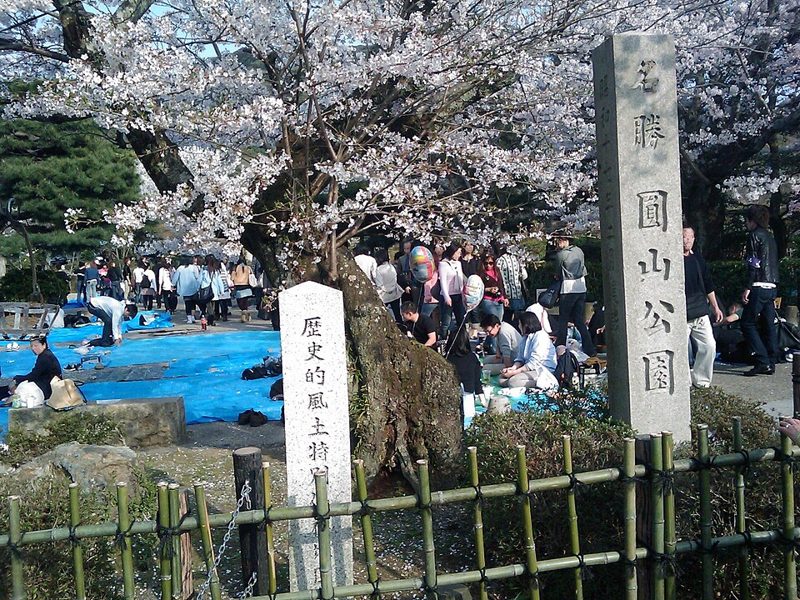
Established on December 25, 1886, Maruyama Park is Kyoto City's oldest public park. Its strolling garden was completed in 1914 by Jihei Ogawa VII, while approximately 650 cherry trees make the grounds one of Kyoto's best-known spring destinations. At the center stands the famous Gion weeping cherry, planted in 1949 to succeed an earlier tree that died in 1947.
Kyochika's take
Kyochika recommends approaching from Yasaka Shrine and exploring beyond the central cherry tree toward Hyotan Pond and the garden's eastern slopes. This route is particularly suitable for travelers interested in landscape architecture, because the pond, stone arrangements and watercourse reveal the design underlying the seasonal scenery.
For spring visitors, we suggest comparing the famous weeping cherry in daylight with its appearance during an officially announced evening illumination. Outside the blossom season, concentrate on the historic garden design and the relationship between the park and the neighboring temple precincts.
Hours, admission and access
- Hours
- Open at all times. The Kyoto Prefecture Tourism Federation lists unrestricted public entry.
- Closed
- No regular closing days.
- Admission
- Free admission to the public park.
- Access
- Kyoto City Bus to Gion stop, approximately 3 minutes on foot. The park is also accessible through Yasaka Shrine from Shijo Street.
- Nearest station
- Gion-Shijo Station
Checked against official information on 2026-10-28. Details change, so check the official website before you go.
Sources: Kyoto City - Maruyama Park, Maruyama Park Official Website, Kyoto Prefecture Tourism Federation, Kyoto City Official Travel Guide - Maruyama Park, Japan National Tourism Organization - Maruyama Park
 Pochikichi's story corner
How did Kyoto's oldest park become a masterpiece of modern garden design?
Maruyama Park occupies a distinctive position on Kyoto's eastern side. Yasaka Shrine borders it to the west, Chion-in lies to the north, and Kodai-ji is located to the south. The eastern edge rises toward the Higashiyama mountains. Kyoto City describes this setting as an important part of the park's identity: a recreational landscape created among established religious precincts and natural hillsides. Rather than occupying an isolated site, the public garden forms part of the larger historical landscape of eastern Kyoto.
Kyoto City officially established the park on December 25, 1886, under the government system for designating public parks. It was transferred from Kyoto Prefecture to Kyoto City in 1889, when municipal government began. The city subsequently expanded the grounds, used the natural hillsides to create valleys, planted seasonal flowers and trees, and developed ponds, fountains and recreational facilities. According to the Kyoto Prefecture Tourism Federation, a fountain using water from the Lake Biwa Canal was installed at Hyotan Pond in 1893.
A defining change came in 1914. Jihei Ogawa VII, the garden designer also known as Ueji, completed a substantial strolling-garden design. The Kyoto Prefecture Tourism Federation specifically highlights his use of artificial stone alongside natural rocks around Hyotan Pond. Some of the artificial stones resemble materials once used as bridge girders. This is an important feature of the garden's character: carefully constructed details form a landscape intended to be experienced while walking. The design relies on the relationship between terrain, stone arrangements, water and vegetation rather than on one ornamental feature alone.
The park's conservation has continued into the present century. Kyoto City completed restoration work on June 30, 2021, including repairs to the garden's watercourse and banks, improvements north of Hyotan Pond, reconstruction of toilet facilities and tree management to recover important views. The work demonstrates that the park's historic value includes its designed landscape structure. So when you visit, look for the stones around Hyotan Pond, the repaired stream and the visual connection between the garden and the surrounding Higashiyama hills.
Sources: Kyoto City - Maruyama Park, Kyoto Prefecture Tourism Federation - Maruyama Park
Long ago, around hereWhat existed here before Maruyama Park?
The modern public park did not exist approximately 1,200 years ago. Its present landscape is the result of much later development on the eastern hillsides of Kyoto. The verified official sources establish the park's geographical relationship with Yasaka Shrine, Chion-in and Kodai-ji, but they do not establish exactly which structures occupied every part of the present park in the early Heian period. It would therefore be misleading to describe its modern pond, paths or garden boundaries as features surviving from that era.
By approximately 150 years ago, the land was approaching the transformation that would create the present public park. Formal designation followed in 1886, and substantial landscaping continued through the following decades. The most important documented stages include the development of Hyotan Pond, the installation of its fountain in 1893 and the strolling-garden design completed in 1914. These changes explain why today's visitors encounter a modern public garden surrounded by much older religious institutions.
Sources: Kyoto City - Maruyama Park History, Kyoto Prefecture Tourism Federation
Hidden highlights
- Hyotan Pond
- Examine the stone arrangements around the water rather than looking only at the pond itself. Official Kyoto Prefecture tourism information identifies the combination of natural and artificial stones as a characteristic of Jihei Ogawa VII's design.
- The historic fountain
- A fountain using water from the Lake Biwa Canal was installed at Hyotan Pond in 1893. It represents an early stage in the park's development before the strolling garden was completed.
- The restored watercourse
- Follow the stream through the garden and observe its relationship with the surrounding banks. Kyoto City's restoration completed in 2021 included substantial repairs to these features.
- The second-generation Gion weeping cherry
- The present tree was raised from seeds collected from its predecessor in 1928 by Sano Toemon XV and planted in 1949. Its history links the park's contemporary spring landscape with an earlier celebrated tree.
- Artificial stonework
- Look for stone elements whose forms differ from the surrounding natural rocks. The Kyoto Prefecture Tourism Federation notes that Ogawa incorporated artificial stones resembling bridge-building materials.
- The Higashiyama hillside setting
- The park's eastern edge joins the Higashiyama landscape. Study how the natural slope, planted garden and paths relate to one another.
Sources: Kyoto City - Maruyama Park, Kyoto Prefecture Tourism Federation
The remarkable history of the Gion weeping cherry
The central weeping cherry is more than a familiar spring landmark. Kyoto City identifies it as the second generation of the celebrated Gion cherry, formally classified as a single-flowered white Higan weeping cherry. The original tree had a trunk-root circumference of approximately 4 meters, stood 12 meters tall and was more than 200 years old. It received natural monument designation in 1938 but died in 1947.
The replacement was already being prepared before the original tree died. In 1928, Sano Toemon XV collected seeds from the first tree and cultivated them. One of the resulting trees was donated and planted at the present site in 1949. Kyoto City records its height as 12 meters, trunk circumference as 2.8 meters and branch spread as 10 meters. The tree therefore carries a documented story of propagation, loss and renewal, rather than simply replacing an older landmark with an unrelated specimen.
Sources: Kyoto City - Gion Weeping Cherry
Why does a natural-looking garden contain artificial stones?
Jihei Ogawa VII's garden design makes deliberate use of materials that do not all originate as naturally shaped rocks. Kyoto Prefecture's official tourism description specifically notes his ability to incorporate artificial stone alongside natural stone. Around Hyotan Pond, some of these materials resemble elements associated with bridge construction.
This detail adds another dimension to the experience of walking through the park. The scene may appear to be an arrangement of water, trees and rocks shaped entirely by nature, but the composition reflects specific choices by a skilled designer. The distinction between natural and manufactured materials is worth examining closely, especially around the pond.
Sources: Kyoto Prefecture Tourism Federation - Garden Design
How to walk it
- Yasaka Shrine approach — Enter from the shrine side and observe the transition from the shrine precinct toward the public park. (5 min)
- Gion weeping cherry — Study the distinctive drooping branches and the tree's position within the central grounds. (10 min)
- Hyotan Pond — Look at the historic fountain and compare the natural and artificial stones used in the garden. (10 min)
- Restored watercourse — Follow the stream and inspect the relationship between flowing water, banks and planted areas. (10 min)
- Eastern garden paths — Explore the terrain rising toward the Higashiyama mountains. (10 min)
- Northern side toward Chion-in — Finish by observing how the park meets the neighboring temple grounds. (5 min)
All route times are Kyochika estimates, not official walking times. The suggested walk totals approximately 50 minutes, excluding extended photography, meals or visits to nearby religious sites.
Sources: Kyoto City - Maruyama Park, Kyoto Prefecture Tourism Federation
Through the seasons
- Early April
- Cherry blossoms are the principal seasonal attraction. Kyoto City's official travel guide specifically identifies early April as a prominent period for blossom viewing.
- Spring evenings
- The central weeping cherry is known for its illuminated appearance during the blossom season. Check the park operator's current announcements for any scheduled illumination.
- Summer
- Explore the planted landscape, watercourse and hillside garden design.
- Autumn
- Look for seasonal changes in the trees and the garden's relationship with the surrounding eastern hills.
- November 7-15, 2026
- The park operator has announced an exhibition of chrysanthemums associated with Kyoto, including Kikutani-giku, Kengai-giku and Saga-giku.
- Winter
- Study the garden's underlying stone arrangements and the form of its trees outside the cherry blossom period.
Getting there by taxi or bus
- Taxi
- Ask for Maruyama Park or Yasaka Shrine in Higashiyama. The most convenient stopping point depends on which part of the park you intend to visit.
- Bus
- Kyoto City Bus routes 100 or 206 to Gion (祇園), as listed by JNTO. The Kyoto Prefecture Tourism Federation gives a walking time of approximately 3 minutes from Gion stop. Verify current bus operation before departure.
- Other
- Gion-Shijo Station is a nearby rail access point. JNTO describes an approach through Yasaka Shrine from Shijo Street.
Sources: Japan National Tourism Organization - Maruyama Park, Kyoto Prefecture Tourism Federation
Pair it with
- Yasaka Shrine — Combine the public garden with the adjoining shrine precinct and its approach from Shijo Street. (3 min walk)
- Chion-in Temple — Explore the relationship between the public park and the neighboring Buddhist temple grounds. (5 min walk)
- Kodai-ji Temple — Extend the visit into southern Higashiyama to compare different religious and garden landscapes. (12 min walk)
Good to know before you go
- The park is open to the public without regular closing days.
- General admission is free.
- The Kyoto Prefecture Tourism Federation lists wheelchair access with assistance.
- Wheelchair-accessible toilets are available according to the Kyoto Prefecture Tourism Federation.
- Assistance dogs are permitted according to the same official tourism source.
- The park operator's official website publishes event and visitor information.
- Kyoto City's official travel guide provides an English-language introduction.
- The park is an outdoor public space, so the historical garden can be explored without purchasing a museum admission ticket.
- No general reservation requirement was identified in the opened official park information.
- No park-wide photography prohibition was identified in the opened official information.
- Individual facilities and organized events may have separate operating arrangements.
- The park connects naturally with the neighboring Yasaka Shrine and Chion-in areas.
Next stop: book for later today PR
Tickets and experiences in Kyoto you can book on Klook. Filter by “Today” to see what is still open.
Kimono rental in Kyoto→Tea ceremony experiences in Kyoto→Kyoto one-day sightseeing tours→All things to do in Kyoto on Klook →Compare on GetYourGuide: Kimono rental in Kyoto · Tea ceremony experiences in Kyoto · Kyoto one-day sightseeing tours
Ad: Klook and GetYourGuide affiliate links.
🍜 Where to eat after
Restaurants near here on Google Maps→Many restaurants in Kyoto take reservations, and some are cash only. Check the restaurant page before you go.
Events nearby
Nov 17 (Tue) – Dec 6 (Sun) 17:30 – 21:30
The illuminated highlights of the head temple of Jodo Buddhism include the Sanmon Gate, Yuzen-en Garden, and Miei-do Hall. In 2026, visitors can also access the corridor on the upper level of Sanmon Gate. Last admission at 9:00 PM.
Details →Oct 23 (Fri) – Dec 13 (Sun) 17:00 – 22:00
See illuminated autumn gardens at Kodaiji, founded by Nene, the wife of Toyotomi Hideyoshi. Projection mapping also transforms the garden in front of the Hojo Hall. Last admission at 9:30 PM.
Details →Art exhibition
Entokuin Temple: Teikan-zu Folding Screens and Autumn Night Light-Up
Entokuin Temple (Kodaiji sub-temple) (Gion-Shijo Sta.)
Oct 23 (Fri) – Dec 13 (Sun) 10:00 – 22:00
The sub-temple of Kodaiji where Nene, the wife of Toyotomi Hideyoshi, spent her final years. It shows the Teikan-zu folding screens handed down in the Toyotomi family, and in autumn lights up its pond-stroll and dry landscape gardens at night. Lights come on at 17:00, last entry is 21:30 and the gate closes at 22:00, with no day/night changeover. Closed December 11 and 12 for temple services.
Details →Festival & seasonal event
Autumn Night Special Viewing (Shoren-in)
Shoren-in Temple (Higashiyama Sta.)
Nov 6 (Fri) – Dec 6 (Sun) 18:00 – 22:00
Evening illumination of the pond garden, bamboo grove and giant camphor trees, inspired by the light of the temple's principal deity. Last entry 9:30 PM; day and night admissions are separate.
Details →Art exhibition
Autumn 2026 Exhibition: Sakamoto Ryoma and the Satsuma-Choshu Alliance at Ryozen Museum of History
Ryozen Museum of History (Bakumatsu Ishin Museum) (Gion-Shijo Sta.)
Sep 16 (Wed) – Nov 23 (Mon) Last entry 17:00. Closed Mondays (open November 2 and 23)
An exhibition for the 190th anniversary of Sakamoto Ryoma's birth and the 160th anniversary of the Satsuma-Choshu Alliance. It introduces recent research that re-examines Ryoma's role using records from Satsuma, Choshu and the shogunate. The second period runs from October 27.
Details →Nov 14 (Sat) – Nov 23 (Mon) 17:30 – 21:30
Murin-an, the former villa of statesman Yamagata Aritomo, opens at night only during the autumn leaf season. Each session includes a short talk by a garden concierge, a stroll through the illuminated garden, and cafe service with matcha or sparkling wine and original sweets. Two sessions (17:30 and 19:30) with 30 places each, booking required on a first-come basis. A day runs only if at least 14 people book. No parking.
Details →
Tips from visitors
Been here? Leave a short tip for the next traveler — in any language. No name, no sign-up.
Thank you! We check every tip by hand and post it within a day or two.
How we post tips: we read every one before it goes up. We remove swear words, insults, ads, links and anything that could identify a person. Tips are shown in the language they were written in, with a translate link. Kyochika never writes or pays for tips, and there are no star ratings.
FAQ
- What is Maruyama Park?
- Established on December 25, 1886, Maruyama Park is Kyoto City's oldest public park. Its strolling garden was completed in 1914 by Jihei Ogawa VII, while approximately 650 cherry trees make the grounds one of Kyoto's best-known spring destinations. At the center stands the famous Gion weeping cherry, planted in 1949 to succeed an earlier tree that died in 1947.
- Hours at Maruyama Park?
- Open at all times. The Kyoto Prefecture Tourism Federation lists unrestricted public entry.
- Closed at Maruyama Park?
- No regular closing days.
- Admission at Maruyama Park?
- Free admission to the public park.
- Access at Maruyama Park?
- Kyoto City Bus to Gion stop, approximately 3 minutes on foot. The park is also accessible through Yasaka Shrine from Shijo Street.
- Is Maruyama Park free?
- Yes. The Kyoto Prefecture Tourism Federation lists unrestricted public entry and no regular closing days.
- When should I visit for cherry blossoms?
- Kyoto City's official travel guide highlights early April, although the exact flowering period changes with the weather.
- Can I visit after dark?
- Yes. The park is publicly accessible without regular closing hours. Any seasonal illumination should be checked separately with the park operator.
- What is worth seeing outside cherry blossom season?
- Hyotan Pond, Jihei Ogawa VII's stone arrangements, the historic watercourse and the park's relationship with the Higashiyama landscape are important features throughout the year.