Temples in Kyoto · Ohara, Sakyo Ward, Kyoto
Jakko-in Temple
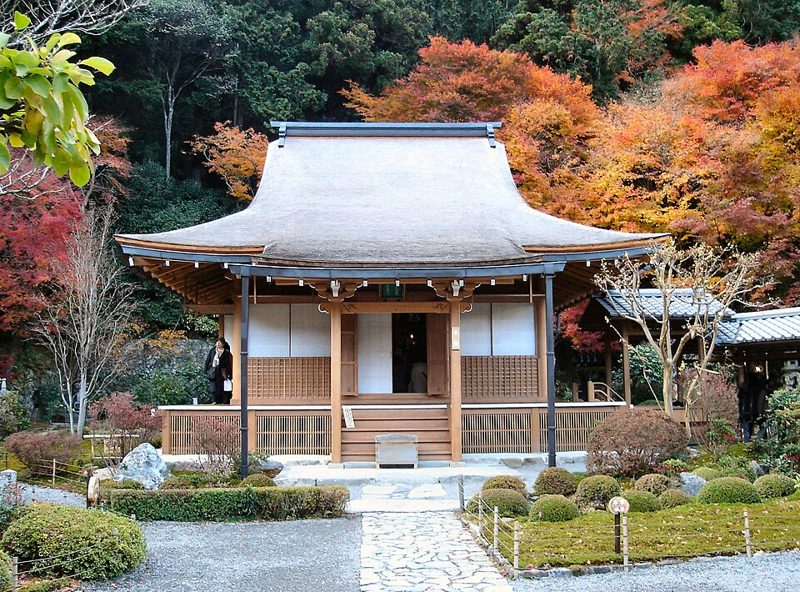
In September 1185, Kenreimon-in Tokuko, the daughter of Taira no Kiyomori and mother of Emperor Antoku, entered Jakko-in after the defeat of the Taira clan. She spent the remainder of her life praying for her son and relatives who had died at Dan-no-ura. The Tendai Buddhist convent traces its founding, according to temple tradition, to Prince Shotoku in 594.
Kyochika's take
Kyochika recommends Jakko-in to travelers who enjoy Buddhist art, medieval literature, women's history and places associated with personal stories rather than only major monuments. Consider visiting in spring, when the garden's cherry trees recall the celebrated imperial visit, or in autumn, when the foliage adds another layer to the approach toward Kenreimon-in's memorial. Reading a short account of The Tale of the Heike before arriving will make the garden, bell and former hermitage more meaningful.
Hours, admission and access
- Hours
- March 1–November 30: 9:00 AM–5:00 PM; December 1–31: 9:00 AM–4:30 PM; January 1–3: 10:00 AM–4:00 PM; January 4–February 28 (February 29 in leap years): 9:00 AM–4:30 PM.
- Closed
- No regular closure is specified on the official admission page.
- Admission
- Adults ¥600; high school students ¥600; junior high school students ¥350; elementary school students ¥100. For groups of at least 30 junior or senior high school students, the respective rates are ¥300 and ¥500 per student.
- Access
- From Kyoto Station, take Kyoto Bus route 17 or 18 from stop C3. From Demachiyanagi Station, take Kyoto Bus route 10, 16 or 17. From Kokusaikaikan Station, take Kyoto Bus route 19. Get off at Ohara and walk approximately 15 minutes.
- Nearest station
- Kokusaikaikan Station (subway connection); Ohara bus stop (closest bus stop)
Checked against official information on 2026-10-28. Details change, so check the official website before you go.
Sources: Jakko-in Official Admission and Hours, Jakko-in Official History, Jakko-in Official Grounds Guide, Jakko-in Official Access, Jakko-in Official Sutra Copying and Tea, Kyoto City Official Travel Guide, Japan National Tourism Organization
 Pochikichi's story corner
How did a woman from the imperial court find her final home in an Ohara convent?
Jakko-in is a Tendai Buddhist convent whose founding is traditionally attributed to Prince Shotoku in 594. According to the temple's own history, he established it to pray for the repose of his father, Emperor Yomei. Its original principal image was said to have been a Jizo figure created by Prince Shotoku, although that original image no longer survives. The temple identifies Tamateruhime, also known by the Buddhist name Ezen, as its first abbess. Its records acknowledge that the detailed succession of early abbesses cannot be reconstructed from surviving historical documents.
Awa no Naishi, daughter of Fujiwara no Shinzei, entered Jakko-in in 1165 and is treated by the temple as its second abbess. Before entering religious life, she had served Kenreimon-in at the imperial court. The temple also connects Awa no Naishi with the image of the Ohara woman carrying firewood for sale. The tradition brings together courtly religion and the working lives of the mountain settlement.
The convent acquired its most famous historical association in 1185, when Kenreimon-in Tokuko entered after the Taira clan's defeat. Tokuko was the daughter of Taira no Kiyomori, consort of Emperor Takakura and mother of Emperor Antoku. At Jakko-in she took the religious name Shinnyokaku and devoted herself to memorial prayers for the Taira family. In spring 1186, the retired Emperor Go-Shirakawa visited her in Ohara. The encounter became the celebrated Ohara Visit episode of The Tale of the Heike, in which memories of imperial grandeur stand beside a life of Buddhist renunciation.
Jakko-in's architecture changed through later centuries. The temple records a repair undertaken in 1603 by Toyotomi Hideyori, with Katagiri Katsumoto supervising the work, and subsequent restoration efforts connected with Hideyori, Yodo-dono and Tokugawa Ieyasu. On May 9, 2000, a fire destroyed the main hall and damaged its Kamakura-period Jizo statue. The original statue was conserved under the guidance of the Agency for Cultural Affairs and housed in a storage facility. A faithfully reproduced image now occupies the reconstructed main hall, completed on June 2, 2005. So when you visit, look for the way the renewed building, historic garden and surviving memorial sites preserve different layers of the temple's past.
Sources: Jakko-in Official History, Jakko-in Official Grounds Guide
Long ago, around hereWhat did this mountain setting mean before it became a literary pilgrimage?
Roughly 1,200 years ago, Jakko-in was already associated with the early Buddhist convent tradition described in its temple history. Its traditional foundation reaches further back, but the temple explicitly acknowledges that documentation for the succession of early abbesses is incomplete. By the later Heian period, the institution had connections with court women who entered religious life. Kenreimon-in's arrival in 1185 transformed the convent into a memorial setting for the fall of the Taira clan. The landscape subsequently became inseparable from the Ohara Visit episode of The Tale of the Heike.
Around 400 years ago, the temple was preserving and renewing its buildings through work associated with Toyotomi Hideyori and other powerful patrons. The main hall that survived into the modern era retained architectural characteristics of those earlier periods. Around 150 years ago, Jakko-in continued as a religious institution whose historical identity was tied to Kenreimon-in. Its most consequential modern transformation came in 2000, when fire destroyed the old main hall, followed by reconstruction in 2005. The present precincts therefore combine older memorial locations and cultural traditions with a carefully reconstructed principal building.
Sources: Jakko-in Official History, Jakko-in Official Grounds Guide
Hidden highlights
- Shihosho-men-no-ike Pond
- East of the main hall, this pond is designed to be appreciated from every direction. Water enters from the northern hillside through a small waterfall divided into three levels, while a surrounding path allows visitors to compare the planted views.
- Snow-Viewing Lantern
- The iron lantern near the main hall is traditionally associated with a donation from Fushimi Castle during rebuilding attributed to Toyotomi Hideyoshi. Its fire chamber incorporates pierced paulownia designs, making the metalwork itself worth examining.
- Kenreimon-in's Former Hermitage
- Behind the main hall is the place traditionally identified as Kenreimon-in's dwelling. A commemorative stone stands at the site, and a well said to have been used by her remains nearby.
- Bell of Impermanence
- The Edo-period bell tower holds a bell bearing an inscription dated 1752. Its name recalls the Buddhist teaching of impermanence at the heart of The Tale of the Heike.
- Hochimatsuden Treasure Hall
- Built in autumn 2006 to commemorate the main hall's reconstruction, the hall displays cultural materials connected with the temple and The Tale of the Heike. A museum shop is also included.
- Ohara West Mausoleum
- The memorial traditionally associated with Kenreimon-in's burial place provides a final point of connection with her life after the fall of the Taira clan. The temple's grounds guide identifies it as one of the places to visit within the historic setting.
Sources: Jakko-in Official Grounds Guide, Jakko-in Official History
The retired emperor's visit and the garden that remembers it
The temple dates the celebrated visit of the retired Emperor Go-Shirakawa to late April 1186. The story places Kenreimon-in in a mountain dwelling after the catastrophe that ended the Taira clan's rule. The encounter became a defining passage in The Tale of the Heike, particularly through its contrast between former imperial status and the simplicity of religious life.
Jakko-in's garden preserves elements associated with this episode, including the pond and the famous cherry and pine trees mentioned in the literary setting. The old pine, known as Himekomatsu, died after the 2000 fire and was later cut down because of the danger of collapse. The temple continues to honor it as a sacred tree. Its loss gives the garden's connection with Buddhist impermanence a modern dimension.
Sources: Jakko-in Official History, Jakko-in Official Grounds Guide
Why the Jizo statue in the main hall is not the medieval original
The former principal image was a Jizo statue dating to the Kamakura period. It was damaged during the fire of May 9, 2000. Rather than replace the historic sculpture entirely, the temple arranged for the surviving original to be conserved with guidance from the Agency for Cultural Affairs. It is housed separately in a storage facility within the precincts.
The statue now installed in the main hall was reproduced to match the former image in form and size. Its coloring reflects the appearance of the Kamakura-period original. The difference between the preserved historic object and the new devotional image is an important part of understanding Jakko-in today: reconstruction here involves both conserving material history and continuing religious practice.
Sources: Jakko-in Official History
How to walk it
- Ohara bus stop — Follow the approach to Jakko-in. (15 min)
- Temple reception — Enter the precincts and check the availability of the treasure hall and optional experiences. (5 min)
- Main hall — Examine the reconstructed building and its principal Jizo image. (10 min)
- Shihosho-men-no-ike Pond — Follow the pond's surrounding path and look at the three-stage waterfall. (8 min)
- Snow-Viewing Lantern and garden — Inspect the lantern's metalwork and the garden associated with The Tale of the Heike. (8 min)
- Former hermitage — Find the memorial stone and well associated with Kenreimon-in. (7 min)
- Bell of Impermanence — Look for the Edo-period bell tower and consider the meaning of the bell's name. (5 min)
- Hochimatsuden Treasure Hall — Explore the displays associated with the temple and its literary history, if open. (15 min)
- Ohara West Mausoleum — Complete the visit at the memorial associated with Kenreimon-in. (15 min)
The 15-minute walk from Ohara bus stop is stated by Jakko-in. All remaining times are Kyochika's suggested planning estimates, not official durations. Individual building access and paths should be confirmed on arrival.
Sources: Jakko-in Official Access, Jakko-in Official Grounds Guide
Through the seasons
- Spring
- Look for the cherry trees near the main hall and the garden that recalls the imperial visit described in The Tale of the Heike.
- Summer
- Explore the garden's planted banks and the small waterfall feeding Shihosho-men-no-ike Pond.
- Autumn
- Consider including the mausoleum and the surrounding garden in a visit focused on seasonal foliage.
- Winter
- Plan around the temple's shorter winter opening hours and its separate New Year schedule.
Getting there by taxi or bus
- Taxi
- Destination: Jakko-in Temple, 676 Ohara Kusao-cho, Sakyo-ku, Kyoto. No official fixed taxi fare or journey duration was verified.
- Bus
- Kyoto Bus routes 17 or 18 from Kyoto Station, routes 10, 16 or 17 from Demachiyanagi, or route 19 from Kokusaikaikan. Get off at Ohara (大原) and walk approximately 15 minutes.
- Other
- Kokusaikaikan Station is a subway interchange for Kyoto Bus route 19, not the temple's immediate entrance. Ohara bus stop is the practical public transport access point.
Sources: Jakko-in Official Access
Pair it with
- Sanzen-in Temple — Combine Jakko-in's Heike-related history with another Buddhist temple in Ohara. (Walking time not independently verified min walk)
- Ohara Village — Explore the village setting associated with Jakko-in and the Ohara women described in the temple's history. (15 minutes to Ohara bus stop from Jakko-in min walk)
Good to know before you go
- The official admission page lists adult and high school admission at ¥600, junior high school admission at ¥350 and elementary school admission at ¥100.
- Religious practitioners, visitors with physical disabilities and teachers accompanying students are listed among those eligible for admission-fee exemption.
- Groups of at least 10 visitors are asked to contact the temple in advance for smoother arrangements.
- Sutra copying costs ¥1,200, with reception generally from 9:00 AM until around 3:00 PM.
- The temple's tea experience costs ¥500, with reception from 10:00 AM to 3:00 PM.
- The tea experience features a temple sweet containing red shiso from Ohara. The temple advises that supplies are limited.
- Requests for sutra copying and tea can be made at reception during a visit.
- The official website offers an English-language option.
- Payment methods, photography restrictions and luggage-storage facilities were not established by the verified official pages. Ask staff about current arrangements.
- The original Kamakura-period Jizo statue is conserved in a storage facility rather than installed as the principal image in the main hall.
Next stop: book for later today PR
Tickets and experiences in Kyoto you can book on Klook. Filter by “Today” to see what is still open.
Kimono rental in Kyoto→Tea ceremony experiences in Kyoto→Kyoto one-day sightseeing tours→All things to do in Kyoto on Klook →Compare on GetYourGuide: Kimono rental in Kyoto · Tea ceremony experiences in Kyoto · Kyoto one-day sightseeing tours
Ad: Klook and GetYourGuide affiliate links.
🍜 Where to eat after
Restaurants near here on Google Maps→Many restaurants in Kyoto take reservations, and some are cash only. Check the restaurant page before you go.
Tips from visitors
Been here? Leave a short tip for the next traveler — in any language. No name, no sign-up.
Thank you! We check every tip by hand and post it within a day or two.
How we post tips: we read every one before it goes up. We remove swear words, insults, ads, links and anything that could identify a person. Tips are shown in the language they were written in, with a translate link. Kyochika never writes or pays for tips, and there are no star ratings.
FAQ
- What is Jakko-in Temple?
- In September 1185, Kenreimon-in Tokuko, the daughter of Taira no Kiyomori and mother of Emperor Antoku, entered Jakko-in after the defeat of the Taira clan. She spent the remainder of her life praying for her son and relatives who had died at Dan-no-ura. The Tendai Buddhist convent traces its founding, according to temple tradition, to Prince Shotoku in 594.
- Hours at Jakko-in Temple?
- March 1–November 30: 9:00 AM–5:00 PM; December 1–31: 9:00 AM–4:30 PM; January 1–3: 10:00 AM–4:00 PM; January 4–February 28 (February 29 in leap years): 9:00 AM–4:30 PM.
- Closed at Jakko-in Temple?
- No regular closure is specified on the official admission page.
- Admission at Jakko-in Temple?
- Adults ¥600; high school students ¥600; junior high school students ¥350; elementary school students ¥100. For groups of at least 30 junior or senior high school students, the respective rates are ¥300 and ¥500 per student.
- Access at Jakko-in Temple?
- From Kyoto Station, take Kyoto Bus route 17 or 18 from stop C3. From Demachiyanagi Station, take Kyoto Bus route 10, 16 or 17. From Kokusaikaikan Station, take Kyoto Bus route 19. Get off at Ohara and walk approximately 15 minutes.
- What makes Jakko-in historically important?
- The temple is associated with Kenreimon-in Tokuko, who entered in 1185 and spent the rest of her life praying for the Taira family after its defeat. Her story forms an important part of The Tale of the Heike.
- Is the main hall original?
- No. The earlier hall was destroyed by fire in 2000. The reconstructed building was completed on June 2, 2005.
- How do I reach Jakko-in from Kyoto Station?
- Take Kyoto Bus route 17 or 18 from stop C3 toward Ohara, get off at Ohara, and walk approximately 15 minutes.
- Can visitors take part in sutra copying?
- Yes. The official website lists a sutra-copying experience costing ¥1,200, with reception generally from 9:00 AM to around 3:00 PM.