Shrines in Kyoto · Fushimi–Uji
Fushimi Inari Taisha
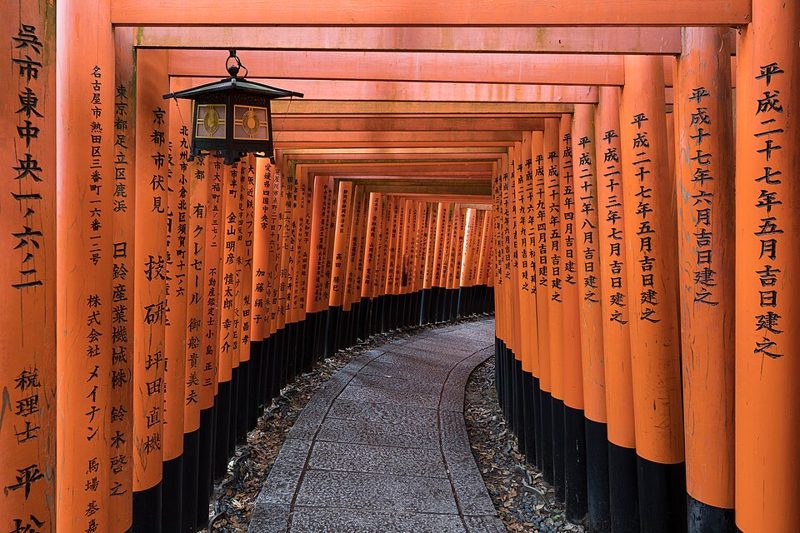
Fushimi Inari Taisha is famous for its thousands of vermilion torii gates, but the real heart of this shrine is the sacred mountain rising behind them. It is the head shrine of an estimated 30,000 Inari shrines across Japan. The tunnels of gates are more than a beautiful photo opportunity: they are expressions of gratitude and prayer, part of a tradition that spread during the Edo period.
🎧 Free English audio guide: Fushimi Inari Taisha: Through the Gates of Time with Pochika and Pochikichi →Kyochika's take
For a first visit, follow the route from the Romon gate to the main sanctuary, through the Senbon Torii gates, and on to the Okusha prayer area. Allow approximately 45–70 minutes for this shorter route, or 2–3 hours if you want to explore the sacred sites farther up Mount Inari. The traditional streets near Inari and neighboring Azumamaro Shrine also make worthwhile additions.
Hours, admission and access
- Admission
- Free entry to the shrine grounds
- Access
- Immediately outside Inari on the JR Nara Line, or a 5-minute walk east from Fushimi-inari on the Keihan Main Line.
- Nearest station
- Inari
Checked against official information on 2026-10-28. Details change, so check the official website before you go.
Sources: Fushimi Inari Taisha: Access, Fushimi Inari Taisha: Official Website, Fushimi Inari Taisha: Visitor Guidelines (Japanese), Kyoto City GIS Data
 Pochikichi's story corner
Why did the Inari deity come to live on this mountain?
According to shrine tradition, Fushimi Inari Taisha was founded on the first Horse Day of the second lunar month in 711. Qin no Irogu, a leading member of the powerful Hata clan of the Fukakusa area, is said to have enshrined deities on the three peaks of Mount Inari under an imperial command. That year, the land reportedly produced abundant grain, while silk cultivation and weaving prospered. People understood this good fortune as a blessing from the gods. This is the shrine's traditional founding story rather than a historically verified account.
Even the name Inari comes with a remarkable legend. An ancient account preserved in fragments of the Fudoki, regional records of early Japan, tells how Irogu shot an arrow at a rice cake. The cake transformed into a white bird, flew away, and landed on a mountain peak, where rice began to grow. This miraculous event is said to have given Inari its name. Originally associated with agriculture and food, Inari later became widely worshipped for business prosperity and household well-being.
The famous corridors of torii gates were not part of the original shrine. During the Edo period, worshippers increasingly donated gates to express their prayers and gratitude. Farther up Mount Inari, roughly 10,000 stone monuments known as otsuka commemorate the individual names and forms under which people worship Inari. So after photographing the torii, continue beyond the Okusha prayer area and look at the sacred mountain itself.
Sources: Fushimi Inari Taisha: About the Shrine, Fushimi Inari Taisha: Enshrined Deities (Japanese), Fushimi Inari Taisha: Senbon Torii (Japanese), Fushimi Inari Taisha: Mount Inari (Japanese)
Long ago, around hereWhat stood here centuries ago?
Long before Kyoto became Japan's capital, the Fukakusa area was closely associated with the powerful Hata clan. The Nihon Shoki, an early Japanese historical chronicle, records the story of Hata no Otsuchichi, a resident of Fukakusa who entered the service of Emperor Kinmei. The Hata clan became influential in ancient Yamashiro Province. Another branch associated with Uzumasa is traditionally linked to irrigation projects along the Katsura River and the development of the capital. Qin no Irogu, the legendary founder of Fushimi Inari Taisha, belonged to this wider clan tradition.
During the medieval period, shrines stood on the sacred peaks of Mount Inari, but they were destroyed during the Onin War. Their former locations survived as sacred sites, while worship continued both at the foot of the mountain and along the pilgrimage paths. The grounds also once contained a Buddhist temple called Aizen-ji, which disappeared during the early Meiji period when Shinto and Buddhism were formally separated. As you explore Mount Inari, look beyond the torii gates to the sacred sites and stone monuments scattered along the paths.
Sources: Fushimi Inari Taisha: History Before the Founding of the Shrine (Japanese), Fushimi Inari Taisha: Frequently Asked Questions (Japanese), Fushimi Inari Taisha: Mount Inari (Japanese)
Lesser-known things to discover
- Omokaru Stones
- At the Okusha prayer area, lift a stone while making a wish. Tradition says that if it feels lighter than expected, your wish is likely to come true.
- Sacred Otsuka Stones
- Thousands of stones bearing sacred names are scattered across the mountain, each reflecting the devotion of worshippers to their own manifestation of Inari.
- Gozen-dani Prayer Area
- A sacred place on Mount Inari where offerings are presented to the deities, preserving the mountain's long-established religious traditions.
- Azumamaro Shrine
- A neighboring shrine dedicated to Kada no Azumamaro, a scholar whose work helped advance the study of classical Japanese literature, including the Man'yoshu poetry collection.
Sources: Fushimi Inari Taisha: Okusha Prayer Area (Japanese), Fushimi Inari Taisha: Mount Inari (Japanese), Fushimi Inari Taisha: Shrine Grounds Map (Japanese), Fushimi Inari Taisha: Surrounding Area Map (Japanese)
Through the seasons
- Spring
- The first Horse Day of February is traditionally celebrated as a day connected with the founding of Inari worship.
- Summer
- The mountain becomes lush and green, offering a seasonal setting for visiting its sacred sites and stone monuments.
- Autumn
- October brings ceremonies including the Koin Taisai, tea-offering ceremony, and rice-harvest ritual. The Hitaki Fire Festival takes place in November.
- Winter
- On January 5, a mountain ceremony of the Oyama Festival is held at the Gozen-dani prayer area.
Good to know before you go
- This is an active place of worship. Do not block narrow paths or obstruct other visitors to take photographs.
- Eating while walking and eating or drinking outside designated areas are prohibited.
- Drones, entry into restricted areas, and commercial photography or photography in prohibited locations are not allowed.
- Walking or visiting with pets is generally prohibited. Assistance dogs needed for worship are exempt.
- Roads around the shrine can become congested, and the shrine recommends using public transport.
Events nearby
Festival & seasonal event
Special Autumn Foliage Viewing 2026 at Tentokuin Temple
Tentokuin Temple (Tofukuji Sta.)
Nov 14 (Sat) – Dec 6 (Sun) 09:00 – 20:30
A special viewing of moss gardens and autumn leaves at a subtemple of Tofukuji. Admission is accepted until 8:00 PM, with illumination beginning around 4:00 PM.
Details →
FAQ
- What is Fushimi Inari Taisha?
- Fushimi Inari Taisha is famous for its thousands of vermilion torii gates, but the real heart of this shrine is the sacred mountain rising behind them. It is the head shrine of an estimated 30,000 Inari shrines across Japan. The tunnels of gates are more than a beautiful photo opportunity: they are expressions of gratitude and prayer, part of a tradition that spread during the Edo period.
- Admission at Fushimi Inari Taisha?
- Free entry to the shrine grounds
- Access at Fushimi Inari Taisha?
- Immediately outside Inari on the JR Nara Line, or a 5-minute walk east from Fushimi-inari on the Keihan Main Line.