Temples in Kyoto · Matsuo, Nishikyo Ward, western Kyoto
Saihoji Temple (Kokedera, the Moss Temple)
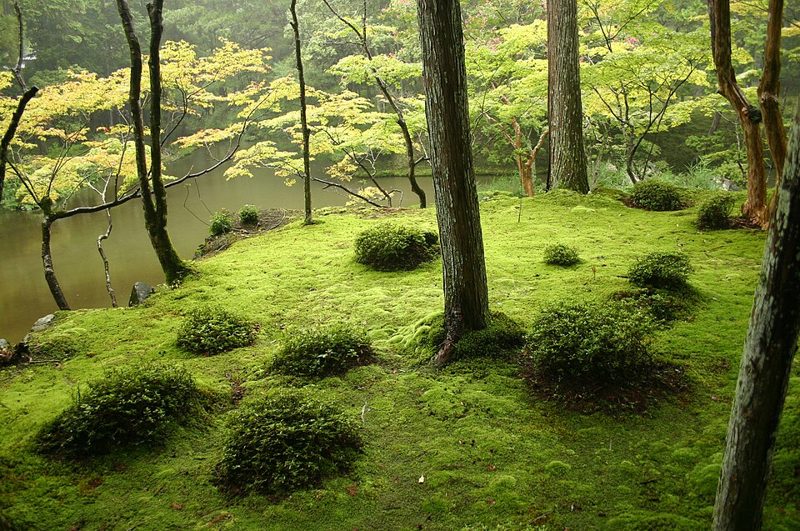
Saihoji's garden contains more than 120 varieties of moss across approximately 35,000 square metres, yet the celebrated green carpet was not part of its original design. Founded by the Buddhist priest Gyoki in 731 and transformed into a Zen temple by Muso Kokushi in 1339, the site acquired its moss-covered character after centuries of warfare, river flooding and natural plant growth. Every standard visit begins with sutra copying before visitors enter the garden.
Kyochika's take
Kyochika recommends Saihoji for travelers interested in Zen Buddhism, historical garden design and the interaction between nature and religious practice. The rainy season is particularly rewarding for studying the changing appearance of the moss, while autumn offers a contrast between green ground cover and red or yellow foliage.
Take the sutra-copying activity seriously as part of the temple experience. Afterward, explore the permitted garden paths without rushing to photograph every view. The temple's upper dry landscape garden is not included in ordinary visits, so concentrate on the publicly accessible lower garden.
Hours, admission and access
- Hours
- Advance-reservation visits only. Nichi-nichi Sanpai, the standard visiting program, takes approximately 60 minutes. Entry sessions and daily closing times are shown on the official reservation calendar; the temple does not provide a fixed daily opening and closing schedule on the reviewed visitor information pages.
- Closed
- Visiting dates are determined by the official reservation calendar. Reservations must be made at least one day before visiting.
- Admission
- Standard Nichi-nichi Sanpai online admission: from 4,000 yen per person. System usage fee: an additional 165 yen per person, including tax, for payments processed on or after October 29, 2026. Online payment by credit card. Standard visits are restricted to visitors aged 13 and over.
- Access
- Hankyu Railway, Kamikatsura Station: approximately 15 minutes on foot. Kyoto Bus to Kokedera Temple, Suzumushidera Temple: approximately 3 minutes on foot. Kyoto City Bus to Suzumushidera Temple, Kokederamichi: approximately 10 minutes on foot.
- Nearest station
- Kamikatsura Station
Checked against official information on 2026-10-28. Details change, so check the official website before you go.
Sources: Saihoji — Official Temple Website, Saihoji — History, Saihoji — Five Seasons, Saihoji — Nichi-nichi Sanpai, Saihoji — Online Reservations, Saihoji — Visitor FAQ
 Pochikichi's story corner
How did a centuries-old Zen garden become Kyoto's Moss Temple?
Saihoji's origins reach back to the Nara period. Its official history records that the Buddhist priest Gyoki founded the temple in 731 as an institution belonging to the Hosso school of Buddhism. The temple originally used different written characters for its name and enshrined Amida Nyorai as its principal deity, accompanied by the bodhisattvas Kannon and Seishi. Gyoki is said to have carved the Amida Triad himself. The surrounding region also had earlier religious associations, including burial mounds of the Hata clan and a tradition connecting the locality with Prince Shotoku.
During the Heian period, Kukai is said to have conducted a Buddhist life-release ceremony at the Golden Pond within the temple grounds. Later, during the Kenkyu era of 1190–1199, Nakahara Morokazu restored the declining temple and welcomed Honen, the founder of the Jodo school of Japanese Pure Land Buddhism. Honen decorated the temple's Amida Triad with gold paint. His disciple Shinran also stayed at the temple. These episodes demonstrate that Saihoji's identity developed through several Buddhist traditions before it became famous as a Zen institution.
The decisive transformation came in 1339. Fujiwara Chikahide, the chief priest of Matsunoo Taisha Shrine, invited the Zen master and garden designer Muso Kokushi to restore Saihoji. Muso converted the temple to the Rinzai school and developed a garden distinguished by stone arrangements expressing Zen spirituality. The Ashikaga shoguns Yoshimitsu and Yoshimasa visited Saihoji, and its garden became a model for the landscapes associated with the Golden and Silver Pavilions. The original garden created under Muso was not the continuous moss-covered landscape seen today.
Saihoji suffered extensive destruction during the Onin and Bunmei War of 1467–1477, followed by a major flood in 1485. Further fires and repeated flooding damaged the temple during subsequent centuries. The floods deposited fertile soil, creating conditions in which moss spread naturally. According to the temple, the transformation took more than 100 years, and by the end of the Edo period the garden was extensively moss-covered. The present main hall, Sairai-do, was rebuilt in 1969 and decorated with abstract sliding-door paintings by Domoto Insho. In 1977, the temple introduced a reservation-based visiting system to protect its garden from excessive foot traffic and to preserve its religious character. So when you visit, look for the relationship between the historic pond, the moss that developed through environmental change, and the temple's continuing Buddhist practices.
Sources: Saihoji — Official History, Saihoji — Five Seasons, Saihoji — Official Temple Website
Long ago, around hereWhat stood here before the moss covered the garden?
Approximately 1,200 years ago, Saihoji already existed as a Buddhist temple founded by Gyoki. Its origins belong to the Nara-period religious landscape, when Emperor Shomu promoted the establishment of temples in the Kinai region. The surrounding area had earlier associations with the Hata clan, whose burial mounds survive in the locality. The temple's history also describes the Heian-period activity of Kukai at the Golden Pond, where he is believed to have conducted a Buddhist life-release ceremony.
Approximately 400 years ago, Saihoji was an established Zen temple whose buildings and gardens had already suffered warfare and flooding. During the Edo period, repeated flooding of the Saihoji River continued to reshape the grounds and encourage the natural spread of moss. By approximately 150 years ago, the moss-covered landscape had become a characteristic feature of the property. The temple's present appearance therefore reflects not only medieval garden design but also centuries of ecological change and later religious restoration.
Hidden highlights
- The upper dry landscape garden
- Muso Kokushi's historic stone garden is among Saihoji's most significant design achievements. It is not accessible during standard Nichi-nichi Sanpai visits and is available only through qualifying special programs.
- The Golden Pond
- The pond is connected to the temple's early Buddhist history, including the tradition that Kukai performed a life-release ceremony here. Its religious significance predates the famous moss landscape.
- The different moss varieties
- The temple identifies more than 120 varieties of moss. Observe differences in color and texture along the permitted paths rather than viewing the garden as a single uniform green surface.
- Sairai-do and Domoto Insho
- The main hall was rebuilt in 1969 and contains abstract sliding-door paintings by Domoto Insho. Photography inside the building is prohibited.
- The weeping cherry
- A weeping cherry stands in front of the main hall and is identified by the temple as a spring attraction. Fresh greenery and azaleas become prominent after the cherry blossoms have fallen.
- The winter moss
- The temple explains that moss remains green in winter despite becoming less active. Staff avoid excessive sweeping during this period to protect the dormant plants.
Sources: Saihoji — Official History, Saihoji — Five Seasons, Saihoji — Visitor FAQ
A shogun who wanted to show his mother the garden
Saihoji's official history recounts a tradition involving Ashikaga Yoshimasa, the shogun associated with Kyoto's Silver Pavilion. Yoshimasa admired Saihoji, but the temple did not permit women to enter at the time. According to the temple's account, one reason the Silver Pavilion's garden was modeled so closely on Saihoji was that Yoshimasa wanted his mother to experience its beauty.
This is presented by Saihoji as a historical story rather than an independently established explanation for every aspect of the Silver Pavilion's construction. It nevertheless conveys the powerful reputation Saihoji's garden enjoyed among medieval Kyoto's ruling elite.
Sources: Saihoji — Official History
The disasters that created the Moss Temple
The landscape most visitors associate with Saihoji emerged partly from destruction. The Onin and Bunmei War caused devastating fires, and repeated flooding brought soil into the grounds. The temple explains that these changed environmental conditions encouraged the natural spread of moss over the former garden.
The process took more than a century. What survives is therefore a combination of Muso Kokushi's historic design and subsequent ecological development. Kyochika suggests considering the moss as part of the garden's long historical transformation rather than as an element installed at a single moment.
How to walk it
- Reception — Check in for the reserved visiting session and follow staff instructions.
- Main hall — Participate in sutra copying before entering the garden.
- Lower garden — Follow the permitted paths and observe the variety of moss and the surrounding planting.
- Pond and garden landscape — Study the relationship between the water, moss, stones and changing seasonal vegetation.
- Return — Complete the garden walk within the visiting period specified by the temple.
The official Nichi-nichi Sanpai program takes approximately 60 minutes, including sutra copying and garden walking. Individual stopping times have not been published in the reviewed official guidance, so they are left null. The upper dry landscape garden is not included in this program and must not be represented as part of the ordinary visitor route.
Sources: Saihoji — Nichi-nichi Sanpai, Saihoji — Visitor FAQ
Through the seasons
- Spring
- The weeping cherry near the main hall blooms, followed by fresh greenery and azaleas.
- Rainy season
- Rain intensifies the green tones of the moss. Oga lotus flowers appear around the end of the rainy season.
- Summer
- Crepe myrtles bloom, while strong sunlight can cause moss to dry and become temporarily less active.
- Autumn
- Red and yellow foliage contrasts with green moss across the garden.
- Winter
- Evergreen moss remains visible among fallen leaves. The temple minimizes sweeping to avoid disturbing dormant plants.
Getting there by taxi or bus
- Taxi
- The temple's visitor FAQ estimates approximately 30 minutes and around 4,000 yen from Kyoto Station. Taxis must use the designated boarding and alighting area approximately 100 metres before the temple gate.
- Bus
- Kyoto Bus route 73 from Kyoto Station to Kokedera Suzumushidera (苔寺・すず虫寺), followed by approximately 3 minutes on foot. Kyoto City Bus access is also available via Suzumushidera Kokederamichi (鈴虫寺・苔寺道), approximately 10 minutes on foot.
- Other
- Hankyu Railway to Kamikatsura Station, followed by approximately 15 minutes on foot. The official temple access information also describes travel via Katsura Station and onward by taxi.
Sources: Saihoji — Official Temple Website, Saihoji — Visitor FAQ
Pair it with
- Suzumushidera Temple — Combine a Saihoji reservation with another temple in the surrounding Matsuo area.
- Matsunoo Taisha Shrine — Explore a shrine historically connected with Saihoji's restoration by Muso Kokushi.
- Katsura Imperial Villa — Compare the Zen garden tradition with the landscape of an early Edo-period imperial residence. Plan separate advance arrangements.
Good to know before you go
- Advance reservation is mandatory for ordinary visits.
- Online booking opens two months before the visit and closes at 11:59 p.m. Japan time on the preceding day.
- Online admission starts at 4,000 yen per person.
- An additional 165-yen system fee per person applies to payments processed on or after October 29, 2026.
- Online reservations require credit-card payment.
- A reservation account is required, and visitor information must be supplied.
- Standard online reservations permit up to two visitors per booking.
- The temple asks visitors to refrain from visiting in groups of more than five people.
- Standard visits are for people aged 13 and over.
- Separate child-friendly programs are offered on selected dates.
- Sutra copying is part of the standard visit. Visitors who cannot participate because of special circumstances should inform temple staff.
- Some chair seating is available in the main hall, but seats cannot be reserved.
- The garden is not wheelchair accessible because of steps and gravel paths.
- Walking sticks are permitted. Staff instructions apply when using them inside buildings.
- Photography is permitted in the garden from designated paths.
- Photography inside buildings, including photographing outside scenery from inside the main hall, is prohibited.
- Tripods, monopods and selfie sticks are prohibited.
- Visitors must not leave the garden paths or block them while taking photographs.
- Eating on temple grounds is prohibited.
- Drinks may be brought in containers with lids.
- Reservation dates and times cannot be changed directly; cancellation and a new reservation are required.
- Cancellation is free up to four days before a visit. The admission cancellation fee is 50% from three days to one day before and 100% on the day.
- The system usage fee is non-refundable.
- Visitors arriving more than 30 minutes late should contact the temple.
- Daily closing times are provided on the official booking calendar.
- The upper garden is not open during ordinary Nichi-nichi Sanpai visits.
- Saihoji has no visitor car park.
Next stop: book for later today PR
Tickets and experiences in Kyoto you can book on Klook. Filter by “Today” to see what is still open.
Kimono rental in Kyoto→Tea ceremony experiences in Kyoto→Kyoto one-day sightseeing tours→All things to do in Kyoto on Klook →Compare on GetYourGuide: Kimono rental in Kyoto · Tea ceremony experiences in Kyoto · Kyoto one-day sightseeing tours
Ad: Klook and GetYourGuide affiliate links.
Tips from visitors
Been here? Leave a short tip for the next traveler — in any language. No name, no sign-up.
Thank you! We check every tip by hand and post it within a day or two.
How we post tips: we read every one before it goes up. We remove swear words, insults, ads, links and anything that could identify a person. Tips are shown in the language they were written in, with a translate link. Kyochika never writes or pays for tips, and there are no star ratings.
FAQ
- What is Saihoji Temple (Kokedera, the Moss Temple)?
- Saihoji's garden contains more than 120 varieties of moss across approximately 35,000 square metres, yet the celebrated green carpet was not part of its original design. Founded by the Buddhist priest Gyoki in 731 and transformed into a Zen temple by Muso Kokushi in 1339, the site acquired its moss-covered character after centuries of warfare, river flooding and natural plant growth. Every standard visit begins with sutra copying before visitors enter the garden.
- Hours at Saihoji Temple (Kokedera, the Moss Temple)?
- Advance-reservation visits only. Nichi-nichi Sanpai, the standard visiting program, takes approximately 60 minutes. Entry sessions and daily closing times are shown on the official reservation calendar; the temple does not provide a fixed daily opening and closing schedule on the reviewed visitor information pages.
- Closed at Saihoji Temple (Kokedera, the Moss Temple)?
- Visiting dates are determined by the official reservation calendar. Reservations must be made at least one day before visiting.
- Admission at Saihoji Temple (Kokedera, the Moss Temple)?
- Standard Nichi-nichi Sanpai online admission: from 4,000 yen per person. System usage fee: an additional 165 yen per person, including tax, for payments processed on or after October 29, 2026. Online payment by credit card. Standard visits are restricted to visitors aged 13 and over.
- Access at Saihoji Temple (Kokedera, the Moss Temple)?
- Hankyu Railway, Kamikatsura Station: approximately 15 minutes on foot. Kyoto Bus to Kokedera Temple, Suzumushidera Temple: approximately 3 minutes on foot. Kyoto City Bus to Suzumushidera Temple, Kokederamichi: approximately 10 minutes on foot.
- Can I visit without making a reservation?
- No. Advance reservations are required at least one day before the visit.
- How much is admission?
- Standard online admission starts at 4,000 yen per person, with an additional 165-yen system fee for payments processed on or after October 29, 2026.
- Can I visit the famous upper Zen garden?
- Not during the standard Nichi-nichi Sanpai program. The upper garden is restricted to qualifying special programs.
- Do I have to copy a sutra?
- Yes. Sutra copying is part of the standard visit. Visitors who cannot participate for special reasons should consult the temple staff.