Temples in Kyoto · Ichijoji, Sakyo Ward, Kyoto
Manshuin Monzeki Temple
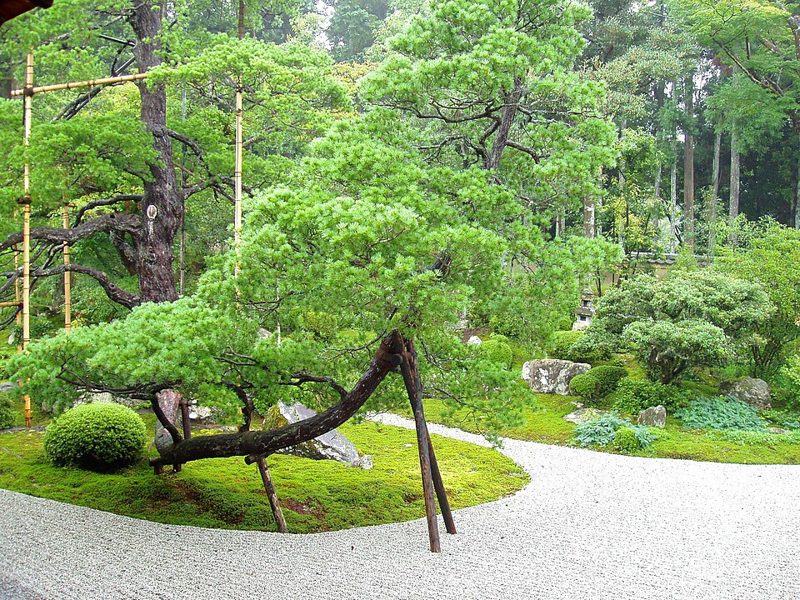
Manshuin traces its origins to the Enryaku era (782–806), when Saicho established a place of prayer on Mount Hiei. In 1656, Imperial Prince Ryosho rebuilt the temple at its present location, creating an architectural ensemble closely related to the courtly design traditions of Katsura Imperial Villa. Its garden contains a Japanese white pine approximately 400 years old, while the reception rooms preserve elaborate shelves, painted partitions, and distinctive architectural fittings.
Kyochika's take
Kyochika recommends Manshuin to visitors interested in imperial culture, Japanese residential architecture, and gardens designed to be contemplated from adjoining rooms. The relationship between the O-shoin, Ko-shoin, and dry landscape garden is particularly rewarding when viewed as a single architectural composition.
For a seasonally focused visit, consider early May, when the temple's Kirishima azaleas flower, or autumn, when foliage changes the garden's colors. The decorative interiors also provide a compelling reason to visit outside these seasons, although access to individual rooms should be confirmed locally.
Hours, admission and access
- Hours
- 9:00 a.m. – 5:00 p.m. (Last admission at 4:30 p.m.)
- Closed
- No regular closing days, according to the Kyoto Prefectural Tourism Federation.
- Admission
- Adults ¥800; high school students ¥500; elementary and junior high school students ¥400. The temple's official English website lists the general admission fee as ¥800.
- Access
- Eizan Railway: About a 20-minute walk from Shugakuin Station. Kyoto City Bus: About a 20-minute walk from Ichijoji Shimizucho bus stop. Taxi: About 8 minutes from Kokusai Kaikan Station on the Kyoto Subway.
- Nearest station
- Shugakuin Station
Checked against official information on 2026-10-28. Details change, so check the official website before you go.
Sources: Manshuin Official Website, Manshuin Official Visitor Information, Manshuin Official History, Manshuin Official Temple Grounds, Manshuin Official Gardens, Kyoto Prefectural Tourism Federation
 Pochikichi's story corner
How did a temple founded on Mount Hiei become an imperial architectural retreat?
Manshuin began during the Enryaku era (782–806), when Dengyo Daishi Saicho, founder of the Tendai school of Buddhism, established a place of prayer on Mount Hiei for the protection of the nation. The institution initially belonged to the religious world of the mountain rather than to its present hillside location in Ichijoji. Its history subsequently became intertwined with Kitano Tenmangu Shrine. When that shrine was established during the Tenryaku era (947–957), Zesan Kokushi, a monk born into the Sugawara family, was appointed its first betto, or administrator. Manshuin continued to fulfill this administrative responsibility for approximately 900 years, until the Meiji Restoration.
During the Tennin era (1108–1110), a branch temple was established in Kitayama to administer Kitano Tenmangu. It subsequently moved to the court nobles' quarter within the Imperial Palace. The institution's connection with the court became particularly important in 1656, when Imperial Prince Ryosho entered Manshuin and rebuilt it at the present site. Ryosho was the second son of Imperial Prince Hachijonomiya Toshihito, founder of Katsura Imperial Villa, and a cousin of Emperor Go-Mizunoo. According to the temple, his elder brother, Imperial Prince Toshitada, who was associated with completing Katsura Imperial Villa, advised on the construction.
The O-shoin and Ko-shoin exemplify the architectural legacy of this rebuilding. The temple identifies them as outstanding examples of sukiya-style shoin architecture and draws comparisons with Katsura Imperial Villa and the Kuro-shoin at Nishi Hongwanji. Its official history notes similarities in decorative nail covers, door pulls, and transoms, explaining why Manshuin has been called a small Katsura Imperial Villa. The association is not simply a superficial resemblance: Ryosho's family relationships and involvement in the cultural environment of the imperial court provide historical context for the architecture.
Manshuin's garden extends this courtly sensibility outdoors. The dry landscape before the O-shoin contains Crane Island and Tortoise Island, set within raked sand representing flowing water. The temple describes the Ko-shoin as resembling a covered pleasure boat moving upstream. Its official interpretation also connects the architectural and garden composition with the literary traditions of the Kokin Wakashu. So when you visit, look for the way the reception rooms frame the symbolic landscape, the chrysanthemum decoration, and the carefully arranged architectural details that connect a Buddhist institution with imperial residential culture.
Sources: Manshuin Official History, Manshuin Official Temple Grounds, Manshuin Official Gardens
Long ago, around hereWhat was here before the present temple?
Around 1,200 years ago, Manshuin's religious predecessor was associated with Mount Hiei, where Saicho established a place of prayer during the Enryaku era. The temple later developed an administrative connection with Kitano Tenmangu, established during the Tenryaku era, and moved through Kitayama and the court nobles' quarter before reaching Ichijoji. The official history does not identify a specific building occupying the exact present site during the early Heian period. It is therefore more accurate to describe the temple's institutional origins than to assign an unverified ancient structure to this hillside.
Around 400 years ago, Manshuin was approaching the relocation that shaped the present ensemble. Imperial Prince Ryosho rebuilt it here in 1656, and the temple identifies the surviving O-shoin and Ko-shoin with that year. During the Meiji period, important changes affected the site's ceremonial architecture. In 1872, the former Shinden Hall was surrendered to the government in connection with the establishment of Kyoto Ryo Hospital, a predecessor of the hospital associated with Kyoto Prefectural University of Medicine. The temple reports that reconstruction of the Shinden eventually fulfilled a wish maintained by successive generations of head priests.
Sources: Manshuin Official History, Manshuin Official Temple Grounds
Hidden highlights
- Five white wall stripes
- The walls beside the Chokushimon Gate carry five white horizontal stripes. According to the temple, these indicate its status as a monzeki institution historically headed by members of the Imperial Family.
- Tora-no-ma tiger paintings
- The partition paintings are traditionally attributed to Kano Eitoku. Across the panels, tigers and a leopard appear among bamboo, including a tiger biting a stalk; the elongated bodies are interpreted by the temple as evidence of an artist working imaginatively with an unfamiliar animal.
- Manshuin-dana shelves
- The Tasogare-no-ma contains an arrangement made from approximately ten varieties of wood. Cupboards and staggered shelves combine storage with a carefully balanced architectural design.
- Mount Fuji nail covers
- The Fuji-no-ma contains cloisonne nail covers shaped like Mount Fuji. Each features different colors and cloud patterns, turning small fittings into individual decorative compositions.
- The Japanese white pine
- In the Moki Fuboku Garden, a Japanese white pine approximately 400 years old stands on Crane Island. A Manshuin-style Kirishitan lantern associated with the history of hidden Christians stands beneath it.
- Printed bamboo partitions
- The Take-no-ma features bamboo-and-cloud patterns on woodblock-printed decorative paper. Although the bamboo resembles hand painting, the temple identifies it as printed work associated with the former name Takenouchi Monzeki.
Sources: Manshuin Official History, Manshuin Official Temple Grounds, Manshuin Official Gardens
Why does the visitor entrance carry a Confucian inscription?
The Kuri, historically a temple kitchen and now the visitor entrance, bears a plaque inscribed Biso by Imperial Prince Ryosho, Manshuin's twenty-ninth head priest. The expression comes from the Analects and literally refers to courting the kitchen god. Manshuin's official interpretation emphasizes gratitude toward the hearth and those who work there rather than flattery of influential people.
The inscription is especially interesting in a temple associated with imperial ceremony. Its location recalls the practical labor required to sustain religious and aristocratic life. The temple's Kami-no-daidokoro served distinguished guests and head priests, and the official grounds description notes that menus from its period of use remain displayed there. Together, these spaces preserve an aspect of Manshuin's history that contrasts with the paintings and formal reception rooms.
Sources: Manshuin Official Temple Grounds
Did Imperial Prince Ryosho paint his own portrait?
The Butsuma contains a portrait of Imperial Prince Ryosho that the temple dates to the Edo period. The prince appears seated in a white undergarment and dark robe, holding a folding fan and wearing a short sword. The official description identifies two seals and a handwritten inscription that suggest Ryosho himself may have painted the portrait. This remains an attribution based on the work's identifying features, not an established certainty.
The room also documents the changing use of Manshuin's buildings. Originally a raised formal chamber, it received Buddhist images and other sacred objects when the former Shinden was dismantled during the early Meiji period. These include an Eleven-Headed Kannon traditionally associated with Kitano Tenmangu and a Yakushi Nyorai dated to the Kamakura period. The Butsuma therefore preserves both the temple's religious history and the consequences of architectural change.
Sources: Manshuin Official Temple Grounds
How to walk it
- Chokushimon Gate — Examine the west-facing formal gate and the five white stripes on the surrounding walls before approaching the visitor entrance.
- Kuri — Enter through the designated visitor entrance and look for the Biso plaque by Imperial Prince Ryosho.
- O-genkan and decorated rooms — Where access is permitted, notice the tiger paintings, peacock paintings, and bamboo-patterned partitions described on the official grounds map.
- Ko-shoin — Look for the chrysanthemum transoms, Manshuin-dana shelves, and Mount Fuji nail covers wherever they are visible from the permitted visitor route.
- O-shoin and gardens — Examine the relationship between the reception building, Crane Island, Tortoise Island, and the symbolic flowing water represented by raked sand.
- Shinden area — Where visitor access permits, consider the history of the former ceremonial hall and its reconstruction.
This is Kyochika's suggested sequence based on the temple's official grounds descriptions, not an officially published walking route. The reviewed sources do not specify individual stop times or a complete tour duration, so no numerical walking times are assigned. Actual room access and circulation must follow the temple's current instructions.
Sources: Manshuin Official Temple Grounds, Manshuin Official Gardens
Through the seasons
- Spring
- The temple identifies plum blossoms, cherry blossoms, and camellias among its seasonal plants.
- Early May
- Kirishima azaleas around the O-shoin produce deep crimson flowers beside the dry landscape garden.
- Summer
- Crape myrtles and other seasonal plants provide botanical interest; flowering dates vary.
- Autumn
- The temple identifies autumn foliage as one of the garden's principal seasonal attractions.
- Winter
- Sasanqua camellias and the garden's evergreen elements offer seasonal interest. The temple also illustrates its garden in winter snow.
Getting there by taxi or bus
- Taxi
- The official temple website states approximately 8 minutes by taxi from Kokusai Kaikan Station on the Kyoto Subway.
- Bus
- Kyoto City Bus to Ichijoji Shimizucho (一乗寺清水町), followed by approximately 20 minutes on foot. The opened official temple directions do not identify a specific bus route number.
- Other
- Eizan Railway to Shugakuin Station, followed by approximately 20 minutes on foot.
Sources: Manshuin Official Visitor Information
Pair it with
- Shugakuin Imperial Villa — Compare Manshuin's courtly temple architecture with a large imperial landscape retreat. The Kyoto Prefectural Tourism Federation lists Shugakuin Imperial Villa approximately 0.6 km away in a straight line.
- Enkoji Temple — Combine Manshuin with another temple in the Ichijoji area. The Kyoto Prefectural Tourism Federation identifies Enkoji approximately 0.7 km away in a straight line.
- Shisendo — Explore another historic location in the same district. The Kyoto Prefectural Tourism Federation places Shisendo approximately 0.8 km away in a straight line.
Good to know before you go
- General admission is ¥800 according to the temple's official English visitor information.
- The Kyoto Prefectural Tourism Federation additionally lists high school admission at ¥500 and elementary and junior high school admission at ¥400.
- The last admission is at 4:30 p.m., before the 5:00 p.m. closing time.
- The temple's official website publishes English information about its history, buildings, gardens, and access.
- The Chokushimon Gate is reserved for members of the Imperial Family and their representatives.
- Ordinary visitors enter through the Kuri.
- The official website identifies free parking for 50 passenger cars.
- The Kyoto Prefectural Tourism Federation states that the site is not wheelchair accessible.
- Interior photography permissions and cashless payment options were not confirmed in the official pages reviewed. Visitors should follow posted instructions and ask staff.
- The official grounds guide describes historically important rooms and tea rooms but does not establish that every space is currently open to ordinary visitors.
Next stop: book for later today PR
Tickets and experiences in Kyoto you can book on Klook. Filter by “Today” to see what is still open.
Kimono rental in Kyoto→Tea ceremony experiences in Kyoto→Kyoto one-day sightseeing tours→All things to do in Kyoto on Klook →Compare on GetYourGuide: Kimono rental in Kyoto · Tea ceremony experiences in Kyoto · Kyoto one-day sightseeing tours
Ad: Klook and GetYourGuide affiliate links.
Tips from visitors
Been here? Leave a short tip for the next traveler — in any language. No name, no sign-up.
Thank you! We check every tip by hand and post it within a day or two.
How we post tips: we read every one before it goes up. We remove swear words, insults, ads, links and anything that could identify a person. Tips are shown in the language they were written in, with a translate link. Kyochika never writes or pays for tips, and there are no star ratings.
FAQ
- What is Manshuin Monzeki Temple?
- Manshuin traces its origins to the Enryaku era (782–806), when Saicho established a place of prayer on Mount Hiei. In 1656, Imperial Prince Ryosho rebuilt the temple at its present location, creating an architectural ensemble closely related to the courtly design traditions of Katsura Imperial Villa. Its garden contains a Japanese white pine approximately 400 years old, while the reception rooms preserve elaborate shelves, painted partitions, and distinctive architectural fittings.
- Hours at Manshuin Monzeki Temple?
- 9:00 a.m. – 5:00 p.m. (Last admission at 4:30 p.m.)
- Closed at Manshuin Monzeki Temple?
- No regular closing days, according to the Kyoto Prefectural Tourism Federation.
- Admission at Manshuin Monzeki Temple?
- Adults ¥800; high school students ¥500; elementary and junior high school students ¥400. The temple's official English website lists the general admission fee as ¥800.
- Access at Manshuin Monzeki Temple?
- Eizan Railway: About a 20-minute walk from Shugakuin Station. Kyoto City Bus: About a 20-minute walk from Ichijoji Shimizucho bus stop. Taxi: About 8 minutes from Kokusai Kaikan Station on the Kyoto Subway.
- What does monzeki mean?
- It designates a temple historically headed by members of the Imperial Family. Manshuin's official history identifies the five white stripes on the walls beside the Chokushimon Gate as a visible sign of this status.
- How much is admission?
- The official temple website lists ¥800. The Kyoto Prefectural Tourism Federation specifies ¥800 for adults, ¥500 for high school students, and ¥400 for elementary and junior high school students.
- When can I see the Kirishima azaleas?
- The temple's official garden information identifies early May as their flowering period. Actual conditions may vary with weather.
- Can I walk from Shugakuin Station?
- Yes. The temple's official visitor information states approximately 20 minutes on foot from Shugakuin Station on the Eizan Railway.