Temples in Kyoto · Kurama, Sakyo Ward, Northern Kyoto
Kurama-dera Temple
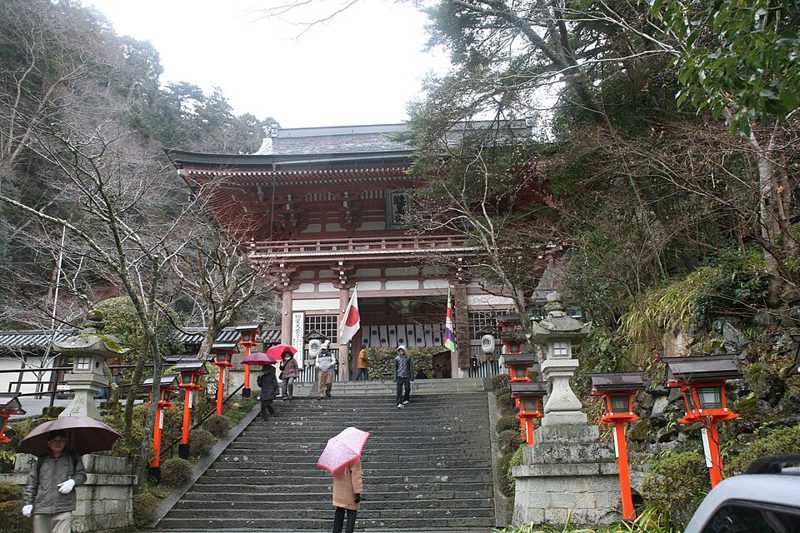
Kurama-dera traces its foundation to 770, when the monk Gantei is said to have followed a white horse into the mountains and received protection from Bishamonten, a Buddhist guardian deity. In 796, Fujiwara no Isehito developed the sanctuary further, bringing together devotion to Bishamonten and Kannon. The mountain later became associated with the childhood of Minamoto no Yoshitsune, the literary world of the Heian court, and a distinctive religious tradition known as Kurama Kokyo.
Kyochika's take
Kyochika recommends Kurama-dera for visitors interested in Buddhist history, Japanese literature, mountain landscapes and the legends surrounding Minamoto no Yoshitsune. The mountain approach is part of the experience, so visitors who are comfortable walking should consider the historic Tsuzuraori path rather than relying entirely on the cable railway.
A morning visit is Kyochika's suggestion for anyone planning to continue across the mountain toward Kifune Shrine. Autumn foliage and spring blossoms provide different seasonal settings, but the temple's religious history deserves attention in any season. Allow time to examine the Main Hall, Kongo-sho, the literary memorials and the forest path instead of treating the site as a single destination reached from the station.
Hours, admission and access
- Hours
- Main Hall: 9:00–16:15. Cable railway: first uphill departure 8:40; last uphill departure 16:20; last downhill departure 16:25. Normal departures every 20 minutes. Reihoden Museum: 9:00–16:00.
- Closed
- Reihoden Museum: Tuesdays (Wednesday when Tuesday is a national holiday), and December 12 through the end of February. Check official announcements for temporary cable railway suspensions and mountain trail restrictions.
- Admission
- Mountain conservation contribution: ¥500. Cable railway contribution: adults ¥200 one way; elementary-school children and younger ¥100 one way. Reihoden Museum: ¥200.
- Access
- Eizan Railway from Demachiyanagi Station to Kurama Station: approximately 30 minutes. Kurama Station to Niomon Gate: approximately 3 minutes on foot. Niomon Gate to the Main Hall via the walking path: approximately 25 minutes. Alternatively, walk approximately 2 minutes from the gate to the lower cable station, ride the cable for approximately 2 minutes, and walk approximately 10 minutes to the Main Hall.
- Nearest station
- Kurama Station (Eizan Railway)
Checked against official information on 2026-10-28. Details change, so check the official website before you go.
Sources: Kurama-dera Official Website, Kurama-dera Official History, Kurama-dera Official Access, Kurama-dera Official Visitor Information, Kurama-dera Official Grounds Guide, Kyoto City Official Travel Guide — Kurama-dera, Kyoto City Official Travel Guide — Kurama and Kibune
 Pochikichi's story corner
How did a white horse, a guardian deity and an aristocratic patron shape Kurama-dera?
The temple's foundation story begins in 770, when the monk Gantei, a disciple of the Buddhist teacher Ganjin, is said to have received guidance through a dream. Following a white horse into Mount Kurama, he encountered a threatening female spirit and was rescued by Bishamonten. He subsequently established a hermitage where he worshipped the deity. This is the temple's traditional founding account, not an independently documented report of supernatural events. It establishes the relationship between the mountain and the protective Buddhist deity that remains important to Kurama-dera.
A further transformation came in 796. Fujiwara no Isehito, who wished to establish a sanctuary dedicated to Kannon, arrived at the mountain and encountered Gantei's existing place of worship. According to the temple's account, a revelation explained that Bishamonten and Kannon were fundamentally united. Isehito developed the temple complex, retained the worship of Bishamonten and later added an image of the Thousand-Armed Kannon. The resulting religious arrangement brought together the protective power associated with Bishamonten and the compassion represented by Kannon.
During the middle Heian period, Kurama-dera became a destination for prominent figures connected with the imperial court. The temple's historical account names Fujiwara no Michinaga, Fujiwara no Yorimichi and Fujiwara no Moromichi among its visitors. Literary references further expanded Kurama's reputation. Sei Shonagon described its winding mountain approach in The Pillow Book, while the Sarashina Diary records a period of religious retreat at Kurama. The temple also identifies the mountain sanctuary depicted in the Wakamurasaki chapter of The Tale of Genji with Kurama-dera. These literary connections demonstrate how a mountain temple beyond the central capital could become part of courtly culture.
In later centuries, Kurama's history accumulated associations with warrior society, popular worship and changing Buddhist traditions. During the Edo period, religious establishments stood along the approach, pilgrims arrived from distant regions, and the mountain's cherry blossoms became sufficiently famous for authorities to issue prohibitions against damaging them. In 1947, Shigaraki Koun brought the temple's diverse traditions together under the name Kurama Kokyo; in 1949, Kurama-dera became the headquarters of that independent religious tradition. So when you visit, look for the relationship between the Main Hall, the Kongo-sho stone arrangement and the surrounding mountain, where the temple presents religious symbolism as part of the landscape itself.
Sources: Kurama-dera Official History, Kurama-dera Official Grounds Guide
Long ago, around hereWhat stood on Mount Kurama before the modern temple buildings?
Roughly 1,200 years ago, Kurama was already a developing Buddhist sanctuary. The traditional foundation in 770 and the expansion associated with Fujiwara no Isehito in 796 place the beginnings of its religious community in the period before and around the emergence of Kyoto as the imperial capital. Its original importance was attached to the worship of Bishamonten and Kannon, not to the precise appearance of the buildings visitors see today. The mountain's religious identity continued to develop as aristocratic visitors and Buddhist practitioners traveled to its sacred sites.
Around 400 years ago, the mountain formed part of a wider network of religious establishments. The temple's history describes subsidiary institutions along the approach, protective talismans distributed in major cities, and worshippers arriving from across Japan. Its fame as a cherry-blossom destination also belonged to this period. Approximately 150 years ago, Kurama still possessed this long-established religious and literary identity, although the modern organization known as Kurama Kokyo had not yet been created. The present landscape therefore represents successive historical layers, from the early Buddhist sanctuary through popular pilgrimage to the independent religious tradition established in the twentieth century.
Sources: Kurama-dera Official History, Kurama-dera Official Grounds Guide
Hidden highlights
- Kongo-sho
- The stone arrangement before the Main Hall is modeled on a star mandala and symbolizes the universal spiritual power that the temple calls Sonten. Look at its geometry in relation to the sanctuary behind it.
- The Guardian Tigers
- Instead of the guardian animals commonly seen at religious entrances, the Main Hall features a pair of tigers associated with Bishamonten. The temple connects their symbolism with the traditional belief that the deity appeared in the month, day and hour of the tiger.
- Ki-no-ne Michi
- The exposed roots along this mountain path form intricate patterns above the ground. The temple explains that hardened sandstone beneath the surface prevented roots from extending downward, and the path is also associated with the legendary training of Ushiwakamaru.
- Akiko Yosano's Study
- Near the museum stands Tohakutei, the relocated study of poet Akiko Yosano. Memorials to Akiko and Hiroshi Yosano connect the mountain with modern Japanese literary culture.
- Reihoden Museum
- The museum contains natural-history displays, temple treasures, memorial exhibits relating to the Yosano poets and Buddhist sculpture. It gives visitors an opportunity to encounter the mountain's cultural and natural history together.
- Niomon Gate
- The gate was rebuilt in 1911, but the temple identifies its left-hand door as dating from approximately 1182–1184. This juxtaposition illustrates how older elements may survive within later architectural reconstructions.
Sources: Kurama-dera Official Grounds Guide, Kurama-dera Official Visitor Information
Who taught the young Yoshitsune to fight?
Minamoto no Yoshitsune, known during childhood as Ushiwakamaru, is one of the figures most closely associated with Mount Kurama. According to the temple's historical account, he entered Kurama at around seven years old and departed for Hiraizumi at approximately sixteen. The temple identifies Toko-bo, formerly situated above Yuki-jinja, as the place where he lived while receiving Buddhist instruction.
The legendary version of his childhood gives the mountain a supernatural dimension. Ushiwakamaru is said to have studied Buddhism by day and learned military techniques from a tengu in Sojogatani at night. The story should be understood as folklore, not a verified historical account of supernatural instruction. The trail, memorials and forest locations associated with Yoshitsune show how the mountain became a landscape of warrior storytelling.
Sources: Kurama-dera Official History, Kurama-dera Official Grounds Guide
Why did Sei Shonagon describe the path to Kurama as deceptively distant?
Sei Shonagon's Pillow Book includes an observation about the winding route to Kurama, describing it as something that seems near but is actually far away. The temple's official history preserves this literary association and identifies the Tsuzuraori approach as the subject of her remark.
The observation gives today's visitor a way to understand the relationship between pilgrimage and landscape. Rather than reaching the principal sanctuary directly from the village entrance, walkers follow a series of turns and climbing sections. Kyochika suggests paying attention to the progression of the path, because the experience of approaching the sanctuary helps explain why the mountain entered Japanese literature.
Sources: Kurama-dera Official History, Kurama-dera Official Website
How to walk it
- Kurama Station to Niomon Gate — Follow the village approach to the temple entrance and examine the gate. (3 min)
- Niomon Gate to Yuki-jinja — Climb toward the shrine associated with the Kurama Fire Festival. (5 min)
- Yuki-jinja to Honden Kondo — Follow the winding Tsuzuraori approach and examine the Main Hall, guardian tigers and Kongo-sho. (20 min)
- Honden Kondo to Reihoden Museum — Continue past the literary memorials and Tohakutei, the relocated study of Akiko Yosano. (2 min)
- Main Hall to Mao-den — Follow the inner mountain route through the areas associated with Ushiwakamaru, including the exposed-root path. (30 min)
- Mao-den to Kifune Shrine — Continue along the mountain route toward the Kibune side and the shrine. (20 min)
The 3-, 5-, 20-, 30- and 20-minute walking sections follow the official Kurama-dera access guide. The additional 2-minute walk to the museum is given in the temple's grounds guide and is an optional detour from the Main Hall. These times are walking guidance, not a complete sightseeing itinerary; stops and trail conditions add to the overall duration. Kyochika recommends checking mountain-path conditions before starting the crossing.
Sources: Kurama-dera Official Access, Kurama-dera Official Grounds Guide
Through the seasons
- Spring
- The temple's historical record identifies Mount Kurama as a famous cherry-blossom destination. Look for seasonal flowers along the mountain approach.
- Summer
- Explore the wooded mountain paths and the religious sites distributed across the slopes. Kyochika recommends suitable walking shoes and attention to changing weather.
- Autumn
- Combine the temple's historic approach with the changing mountain foliage. Kyochika recommends setting aside sufficient daylight for the route.
- Winter
- The mountain remains a religious destination, but the Reihoden Museum closes from December 12 through the end of February. Check conditions before walking on mountain paths.
Getting there by taxi or bus
- Taxi
- Road access is available to Kurama village, but the temple's official route continues on foot from the village entrance. Kurama-dera has no temple-operated parking lot.
- Bus
- Kyoto Bus toward Kurama Onsen, alighting at Kurama (鞍馬). The official access guide gives approximately 25 minutes from Kokusaikaikan Station to Kurama.
- Other
- Take the Eizan Railway from Demachiyanagi Station to Kurama Station, approximately 30 minutes. Walk approximately 3 minutes to Niomon Gate. The temple also provides a mountain walking route toward Kifune Shrine.
Sources: Kurama-dera Official Access
Pair it with
- Yuki-jinja — Visit the shrine associated with the traditional Kurama Fire Festival on the temple approach. (5 min walk)
- Kifune-jinja Shrine — Continue over the mountain to a sanctuary dedicated to the water deity Takaokami. (50 min walk)
- Kurama Village — Explore the settlement around the railway station before entering the temple precinct. (3 min walk)
Good to know before you go
- The Main Hall opens from 9:00 to 16:15 according to the temple's current official homepage.
- The mountain conservation contribution is ¥500.
- The cable railway contribution is ¥200 one way for adults and ¥100 for elementary-school children and younger.
- The cable railway normally runs every 20 minutes.
- The first uphill cable departure is at 8:40.
- The last uphill cable departure is at 16:20, but the temple warns that visitors taking it will arrive after the Main Hall has closed.
- The last downhill cable departure is listed as 16:25.
- The Reihoden Museum opens from 9:00 to 16:00 and has a separate ¥200 admission charge.
- The museum closes on Tuesdays, on the following day when Tuesday is a national holiday, and from December 12 through the end of February.
- Pets may enter the mountain, but they cannot ride the cable railway or enter temple halls.
- The temple operates the cable railway as a religious institution and describes payment as a contribution rather than a conventional commercial fare.
- Toilets are available at various places on the mountain.
- Kurama-dera does not operate its own parking lot.
- The official website provides descriptions of the mountain's historical and religious sites.
- Kyochika recommends allowing extra time for walking because the official route includes mountain paths, steps and changes in elevation.
- Payment-card acceptance, detailed indoor photography restrictions and the availability of English audio guides were not confirmed in the opened official sources.
Next stop: book for later today PR
Tickets and experiences in Kyoto you can book on Klook. Filter by “Today” to see what is still open.
Kimono rental in Kyoto→Tea ceremony experiences in Kyoto→Kyoto one-day sightseeing tours→All things to do in Kyoto on Klook →Compare on GetYourGuide: Kimono rental in Kyoto · Tea ceremony experiences in Kyoto · Kyoto one-day sightseeing tours
Ad: Klook and GetYourGuide affiliate links.
🍜 Where to eat after
Restaurants near here on Google Maps→Many restaurants in Kyoto take reservations, and some are cash only. Check the restaurant page before you go.
Events nearby
Festival & seasonal event
Kifune Shrine Autumn Leaves Illumination
Kifune Shrine, main approach to the Main Shrine (Kibuneguchi Sta.)
Nov 7 (Sat) – Nov 24 (Tue) Lit from sunset until 8:30 PM
The autumn leaves along the main approach to Kifune Shrine's Main Shrine are lit up from sunset. Admission is free; the amulet office is open 9:00 AM to 8:00 PM.
Details →
Tips from visitors
Been here? Leave a short tip for the next traveler — in any language. No name, no sign-up.
Thank you! We check every tip by hand and post it within a day or two.
How we post tips: we read every one before it goes up. We remove swear words, insults, ads, links and anything that could identify a person. Tips are shown in the language they were written in, with a translate link. Kyochika never writes or pays for tips, and there are no star ratings.
FAQ
- What is Kurama-dera Temple?
- Kurama-dera traces its foundation to 770, when the monk Gantei is said to have followed a white horse into the mountains and received protection from Bishamonten, a Buddhist guardian deity. In 796, Fujiwara no Isehito developed the sanctuary further, bringing together devotion to Bishamonten and Kannon. The mountain later became associated with the childhood of Minamoto no Yoshitsune, the literary world of the Heian court, and a distinctive religious tradition known as Kurama Kokyo.
- Hours at Kurama-dera Temple?
- Main Hall: 9:00–16:15. Cable railway: first uphill departure 8:40; last uphill departure 16:20; last downhill departure 16:25. Normal departures every 20 minutes. Reihoden Museum: 9:00–16:00.
- Closed at Kurama-dera Temple?
- Reihoden Museum: Tuesdays (Wednesday when Tuesday is a national holiday), and December 12 through the end of February. Check official announcements for temporary cable railway suspensions and mountain trail restrictions.
- Admission at Kurama-dera Temple?
- Mountain conservation contribution: ¥500. Cable railway contribution: adults ¥200 one way; elementary-school children and younger ¥100 one way. Reihoden Museum: ¥200.
- Access at Kurama-dera Temple?
- Eizan Railway from Demachiyanagi Station to Kurama Station: approximately 30 minutes. Kurama Station to Niomon Gate: approximately 3 minutes on foot. Niomon Gate to the Main Hall via the walking path: approximately 25 minutes. Alternatively, walk approximately 2 minutes from the gate to the lower cable station, ride the cable for approximately 2 minutes, and walk approximately 10 minutes to the Main Hall.
- Can I reach the Main Hall without walking the entire mountain approach?
- Yes. The temple operates a cable railway. From the upper cable station, the official route still requires approximately 10 minutes on foot to reach the Main Hall.
- How much does Kurama-dera cost?
- The mountain conservation contribution is ¥500. The cable railway costs an additional ¥200 one way for adults or ¥100 for elementary-school children and younger. The Reihoden Museum charges ¥200 separately.
- Can I walk from Kurama-dera to Kifune Shrine?
- Yes. The temple describes a route from the Main Hall through Mao-den toward Kifune Shrine. Its official guide allocates approximately 30 minutes to Mao-den and another 20 minutes to Kifune Shrine. Check current path conditions before starting.
- Is the story about Yoshitsune and the tengu historically verified?
- No. The temple presents the account of Ushiwakamaru receiving military instruction from a tengu as a legend. His childhood association with Kurama forms part of the temple's historical narrative.