Temples in Kyoto · Gion, Higashiyama
Kennin-ji Temple
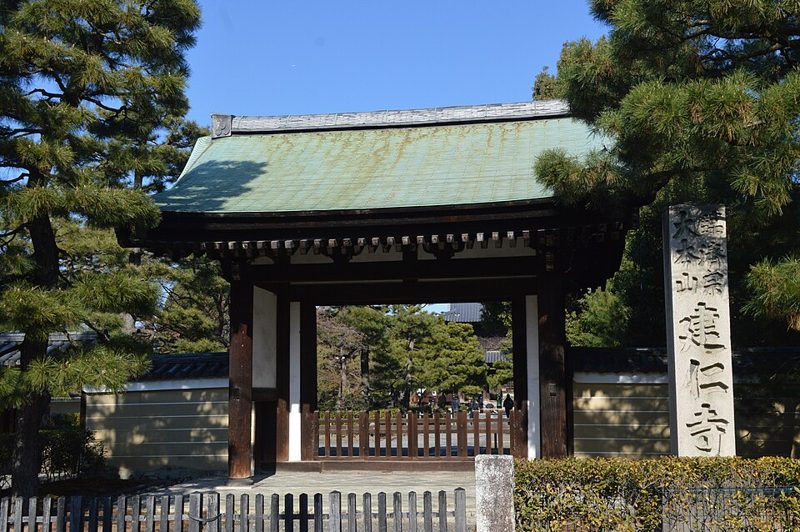
Founded in 1202 under the patronage of shogun Minamoto no Yoriie, Kennin-ji is Kyoto's oldest Zen temple. Its Dharma Hall, constructed in 1765, contains a remarkable ceiling painting of twin dragons by Koizumi Junsaku, dedicated in 2002 to commemorate the temple's 800th anniversary. The monastery brings together medieval Buddhist history, early modern architecture, Zen gardens, and contemporary painting.
Kyochika's take
Kyochika recommends Kennin-ji to visitors who want to understand Zen through architecture, religious imagery, and garden design rather than treating it only as an art destination. The contrast between the historic Dharma Hall and Koizumi Junsaku's modern dragon painting makes an especially rewarding starting point.
For a suggested visit, spend time comparing the gardens rather than viewing them as interchangeable landscapes. In autumn, the maple trees around Choon-tei offer an additional subject to observe. These are Kyochika's editorial suggestions, not official visitor itineraries.
Hours, admission and access
- Hours
- 10:00–17:00. Last admission 16:30.
- Closed
- Special closures for religious ceremonies. Confirmed closure: November 15, 2026, all day.
- Admission
- Adults ¥800; elementary, junior high and high school students ¥500; children below elementary-school age free. Visitors with a disability certificate are admitted free, while accompanying caregivers pay the regular admission fee. From January 1, 2027, adult admission increases to ¥1,000; student admission remains ¥500.
- Access
- 7 minutes on foot from Keihan Gion-shijo Station; 10 minutes from Hankyu Kawaramachi Station. From JR Kyoto Station, Kyoto City Bus 206 or 100 to Higashiyama Yasui, followed by a 5-minute walk.
- Nearest station
- Gion-shijo Station
Checked against official information on 2026-10-28. Details change, so check the official website before you go.
Sources: Kennin-ji Official Website, Kennin-ji Official History, Kennin-ji Official Precinct Guide, Kennin-ji Official Access and Admission, Kennin-ji Official FAQ, Kennin-ji Official Photography Rules, Kennin-ji Official Admission Revision, Kennin-ji November 15 Closure Notice, Kennin-ji Rainy Weather Notice
 Pochikichi's story corner
How did a shogun's foundation become Kyoto's oldest Zen temple?
Kennin-ji was founded in 1202 when Minamoto no Yoriie, the Kamakura shogun, donated land for a monastery headed by Myoan Eisai. Eisai had traveled to Song China, studied Zen Buddhism, and returned to Japan determined to establish its practice. The monastery's buildings were modeled on Chinese Buddhist architecture associated with Mount Baizhang. Its name came from the Ken'nin era in which it was founded. The establishment of Kennin-ji was a significant development in the spread of Zen within Kyoto.
The institution did not originally function as an exclusively Zen monastery. Its initial organization accommodated Tendai Buddhism, esoteric teachings, and Zen, reflecting the religious circumstances of the period. In 1258, Enni Ben'en became associated with the temple's restoration and revived its Buddhist activities. The following year, the Chinese Zen master Lanxi Daolong entered the monastery and introduced stricter monastic regulations. These developments gradually established Kennin-ji as a center devoted to Rinzai Zen practice.
During the Muromachi period, Kennin-ji became one of the Kyoto Gozan, the leading Zen monasteries recognized under the shogunate. Its official history records that it was ranked third in 1386. Political patronage strengthened the institution, but destruction repeatedly interrupted its development. Fires devastated buildings and subsidiary temples. In 1599, Ankokuji Ekei transferred a Hojo building from Ankoku-ji in the Aki region, helping initiate an important phase of reconstruction. Under the Tokugawa government, temple buildings and institutional arrangements continued to develop.
The Dharma Hall was constructed in 1765, while the present Sanmon gate was transferred from An'nei-ji in 1923. During the Meiji period, religious reforms resulted in the consolidation of subsidiary temples and a substantial reduction of the precinct. The twentieth and twenty-first centuries brought further conservation and artistic additions, including the dedication of Koizumi Junsaku's twin dragons in 2002. So when you visit, look for the relationship between the transferred Hojo, the later Dharma Hall, the historic gates, and the modern ceiling painting. Each belongs to a different chapter in Kennin-ji's continuing history.
Sources: Kennin-ji Official History, Kennin-ji Official Precinct Guide
Long ago, around hereWhat was here before the temple took its present form?
Around 1,200 years ago, Kennin-ji had not yet been established. Its documented foundation came in 1202, when Minamoto no Yoriie provided land and Eisai became its founding priest. The original complex followed a Chinese monastic model and accommodated several Buddhist traditions. Over the following centuries, it developed into a Rinzai Zen institution. Its later recognition among Kyoto's Gozan monasteries reflected the importance it acquired under shogunal patronage.
Approximately 400 years ago, Kennin-ji was undergoing reconstruction after earlier destruction. The Hojo transferred in 1599 became an important element of that recovery. During the Tokugawa period, additional buildings and institutions were restored or developed. About 150 years ago, in the early Meiji period, the temple experienced a different kind of transformation: government religious policies led to the consolidation of subsidiary temples and a reduction of its grounds by nearly half. The modern precinct therefore represents survival, relocation, rebuilding, and institutional change rather than an unchanged medieval layout.
Sources: Kennin-ji Official History, Kennin-ji Official Precinct Guide
Hidden highlights
- Chokushimon Gate
- This gate preserves features dating from the late Kamakura period. Marks on its pillars and doors are traditionally associated with arrows from warfare, giving it the alternative names Yanone-mon and Yatate-mon.
- Choon-tei Garden
- The courtyard garden contains a central arrangement of three stones, a meditation stone to the east, and surrounding maple trees. Its composition was designed to be appreciated from multiple directions.
- Circle, Triangle, and Square Garden
- The garden uses elementary geometric forms to express Buddhist ideas. The temple associates the square with earth, the circle with water, and the triangle with fire.
- Tea Monument
- Donated by Gion Tsujiri in 1983, the monument commemorates Kennin-ji's relationship with tea culture. The adjoining tea planting was established in 1991, and the temple states that tea harvesting takes place in May.
- Eleven-Faced Kannon
- The principal image in the Hojo was donated by Tofukumon-in, daughter of Tokugawa Hidetada and consort of Emperor Go-Mizunoo. The sculpture connects the monastery with the political and imperial families of the early modern period.
- Sanmon Gate
- Transferred from An'nei-ji in 1923, this gate is called Bokakuro. Its name refers to a tower looking toward the imperial palace, while its religious symbolism concerns the three gates of liberation.
Sources: Kennin-ji Official Precinct Guide, Kennin-ji Official Buddhist Images and History
The monk who connected Zen with tea
Myoan Eisai studied Buddhism in China before returning to Japan. His journeys exposed him to religious practices and ideas that he subsequently promoted in Japan. Kennin-ji preserves a visible connection between the founding monk and the cultural history of tea through its tea monument and adjoining planting.
The temple records that Gion Tsujiri donated the tea monument in 1983. Tea plants were added nearby in 1991, and harvesting takes place in May. Rather than assuming that a tea ceremony is available within the main temple buildings, visitors can approach the monument as a historical reminder of the relationship between Buddhist practice and tea culture.
Sources: Kennin-ji Official History, Kennin-ji Official Precinct Guide
Why are the dragons centuries younger than the hall?
Kennin-ji's Dharma Hall dates from 1765, but its twin-dragon ceiling painting belongs to the twenty-first century. Koizumi Junsaku created the artwork for the monastery's 800th anniversary, and the dedication ceremony took place on April 14, 2002. The dragons are therefore a modern artistic addition to an older religious building.
Beneath the painted ceiling, the hall houses a seated Shakyamuni Buddha accompanied by Kashyapa and Ananda. The contrast between these Buddhist images and the modern painting reveals how religious art can develop within an established architectural setting. For Kyochika, one of the most rewarding ways to examine the hall is to look first at the altar and then upward to the dragons.
Sources: Kennin-ji Official History, Kennin-ji Official Precinct Guide
How to walk it
- Temple approach — Observe the arrangement of gates and halls before entering the paid viewing area. (5 min)
- Sanmon Gate — Examine the transferred gate and its Buddhist symbolism. (5 min)
- Dharma Hall — Look at the Shakyamuni altar and Koizumi Junsaku's twin-dragon ceiling painting. (12 min)
- Hojo and Daiou-en — Compare the abbot's residence with the dry-landscape garden in front of it. (12 min)
- Choon-tei Garden — Examine the central stones, meditation stone, and surrounding maple trees. (10 min)
- Circle, Triangle, and Square Garden — Identify the three geometric forms and consider their symbolic meanings. (6 min)
- Tea Monument — Look for the monument and the tea planting associated with Kennin-ji's tea heritage. (5 min)
All durations are Kyochika estimates, not official times. This is a suggested sequence rather than an official route. Public access to particular buildings or sections may change according to religious activities and temple instructions.
Sources: Kennin-ji Official Precinct Guide
Through the seasons
- Spring
- Study the relationship between garden stones, gravel, temple architecture, and new foliage.
- May
- The temple states that tea harvesting takes place at its tea planting. This does not establish public participation.
- Summer
- Give particular attention to the indoor Buddhist images and the twin-dragon ceiling.
- Autumn
- Look for the maple foliage surrounding Choon-tei Garden.
- Winter
- Focus on the structure and geometry of the dry-landscape gardens.
Getting there by taxi or bus
- Taxi
- Approximately 10 minutes from JR Kyoto Station, according to the temple's official access information.
- Bus
- Kyoto City Bus 206 or 100 from Kyoto Eki-mae (京都駅前), alighting at Higashiyama Yasui (東山安井); approximately 5 minutes on foot. Other listed stops are Minamiza-mae (南座前), Gion (祇園), and Kiyomizu-michi (清水道).
- Other
- Approximately 7 minutes on foot from Keihan Gion-shijo Station or 10 minutes from Hankyu Kawaramachi Station. Bicycle parking is provided near the west side of the bell tower beyond the north gate.
Sources: Kennin-ji Official Access
Pair it with
- Yasaka Shrine — Kyochika suggests combining the temple's Zen heritage with a visit to a Shinto shrine in the Gion area. (Walking time not verified min walk)
- Kodaiji Temple — Compare another Higashiyama temple's architecture and gardens with Kennin-ji. (Walking time not verified min walk)
- Gion — Continue exploring the neighborhood in which Kennin-ji is located. (Walking time not verified min walk)
Good to know before you go
- The official admission period begins at 10:00 and closes at 17:00, with last admission at 16:30.
- The entire paid viewing area is closed on November 15, 2026, for a religious ceremony.
- Admission for adults is ¥800 in 2026 and increases to ¥1,000 on January 1, 2027.
- Children of elementary-school age or younger cannot enter without accompanying adults.
- Groups of 15 or more must apply at least 10 days before visiting.
- Groups of elementary-school children must also provide advance notice and have appropriate adult supervision.
- Only handheld still photography with cameras or smartphones is permitted, subject to the temple's restrictions.
- Photography is limited to gardens and artworks; posed portraits, commemorative photographs of people, and group photographs are prohibited.
- Video recording is prohibited, including footage for YouTube and TikTok.
- Tripods, monopods, selfie sticks, gimbals, drones, and mounted action cameras are prohibited.
- Photography for commercial or revenue-generating social-media use is prohibited.
- Eating, drinking, smoking, sports, games, and sketching are prohibited within the precinct.
- Pets are generally not permitted.
- Coin lockers are available, and the deposited coin is returned when the locker is opened.
- Goshuin stamps are available only to visitors who have entered the main viewing area.
- The temple does not offer standard guided tours of the main viewing area. Explanatory panels are provided.
- The temple does not provide matcha experiences inside the main temple buildings.
- Visitors whose clothing or socks are excessively wet may be refused admission.
- Check official announcements for temporary suspensions of activities or access.
Next stop: book for later today PR
Tickets and experiences in Kyoto you can book on Klook. Filter by “Today” to see what is still open.
Kimono rental in Kyoto→Tea ceremony experiences in Kyoto→Kyoto one-day sightseeing tours→All things to do in Kyoto on Klook →Compare on GetYourGuide: Kimono rental in Kyoto · Tea ceremony experiences in Kyoto · Kyoto one-day sightseeing tours
Ad: Klook and GetYourGuide affiliate links.
Tips from visitors
Been here? Leave a short tip for the next traveler — in any language. No name, no sign-up.
Thank you! We check every tip by hand and post it within a day or two.
How we post tips: we read every one before it goes up. We remove swear words, insults, ads, links and anything that could identify a person. Tips are shown in the language they were written in, with a translate link. Kyochika never writes or pays for tips, and there are no star ratings.
FAQ
- What is Kennin-ji Temple?
- Founded in 1202 under the patronage of shogun Minamoto no Yoriie, Kennin-ji is Kyoto's oldest Zen temple. Its Dharma Hall, constructed in 1765, contains a remarkable ceiling painting of twin dragons by Koizumi Junsaku, dedicated in 2002 to commemorate the temple's 800th anniversary. The monastery brings together medieval Buddhist history, early modern architecture, Zen gardens, and contemporary painting.
- Hours at Kennin-ji Temple?
- 10:00–17:00. Last admission 16:30.
- Closed at Kennin-ji Temple?
- Special closures for religious ceremonies. Confirmed closure: November 15, 2026, all day.
- Admission at Kennin-ji Temple?
- Adults ¥800; elementary, junior high and high school students ¥500; children below elementary-school age free. Visitors with a disability certificate are admitted free, while accompanying caregivers pay the regular admission fee. From January 1, 2027, adult admission increases to ¥1,000; student admission remains ¥500.
- Access at Kennin-ji Temple?
- 7 minutes on foot from Keihan Gion-shijo Station; 10 minutes from Hankyu Kawaramachi Station. From JR Kyoto Station, Kyoto City Bus 206 or 100 to Higashiyama Yasui, followed by a 5-minute walk.
- Is Kennin-ji Kyoto's oldest temple?
- It identifies itself as Kyoto's oldest Zen temple, founded in 1202, rather than Kyoto's oldest Buddhist temple of any tradition.
- Can visitors photograph the dragons?
- Handheld still photography of artworks is permitted, but video recording, commercial photography, posed portraits, and photographic accessories such as tripods and selfie sticks are prohibited.
- How much is admission?
- Adults pay ¥800 in 2026, students of elementary through high-school age pay ¥500, and children below elementary-school age enter free. Adult admission increases to ¥1,000 from January 1, 2027.
- Does Kennin-ji offer an official guided tour?
- The temple states that visits to the main viewing area are self-guided, without a regular accompanying guide. Explanatory panels are provided.