Gardens & villas in Kyoto · Katsura, Nishikyo Ward, western Kyoto
Katsura Imperial Villa
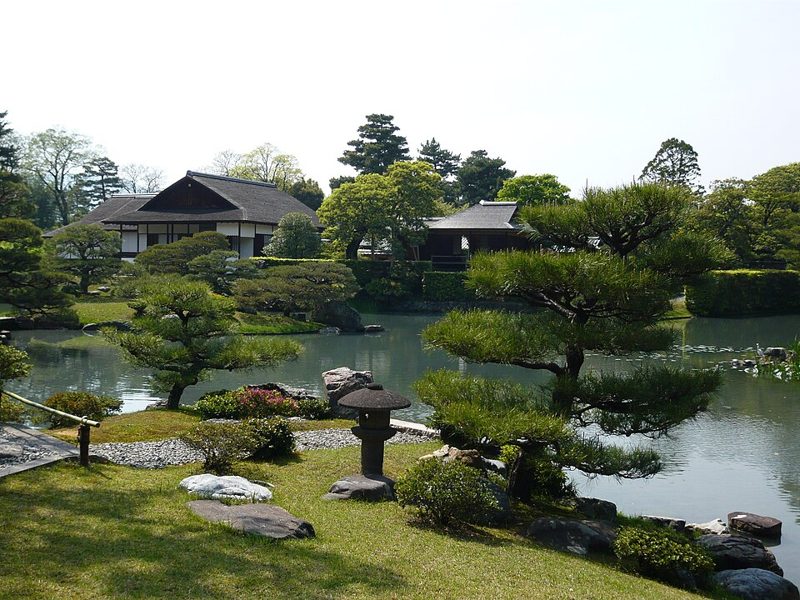
Katsura Imperial Villa was developed over approximately 50 years, from around 1615 to about 1662, by Prince Toshihito and his son Prince Toshitada. Covering approximately 69,000 square metres on the western bank of the Katsura River, the estate combines staggered residential buildings, a pond, teahouses and a private Buddhist hall. Its gardens were created for an imperial world of poetry, music, boating and moon viewing.
Kyochika's take
Kyochika recommends Katsura for visitors interested in traditional architecture, landscape design and the artistic culture of Japan's imperial court. Spring provides opportunities to see azaleas and irises, while autumn brings a changing arrangement of foliage around the pond.
During the guided walk, pay attention to the relationship between the buildings and the landscape rather than looking for a single grand viewpoint. The interiors are excluded from ordinary tours, so focus on roofs, stone paths, architectural openings and the way the pond connects the garden's different structures.
Hours, admission and access
- Hours
- Guided tours only, approximately 60 minutes. English-guided tours for foreign visitors: 9:20, 11:20, 13:20, 15:20 and 16:20. Japanese-guided tours: 9:00, 10:00, 11:00, 12:00, 13:00, 14:00, 15:00 and 16:00. The 16:00 and 16:20 tours do not operate from October through February. During July and August, the 9:00, 9:20, 10:00, 15:00, 15:20, 16:00 and 16:20 slots are primarily available; other slots may open if necessary. Starting times may change for operational reasons.
- Closed
- Mondays; Tuesdays when Monday is a national holiday; December 28 to January 4; and days affected by events or operational requirements.
- Admission
- Visitors aged 18 and over: 1,000 yen per visit. Visitors aged 12–17: free. Children under 12: not admitted. Holders of disability certificates and one accompanying person: free.
- Access
- Hankyu Kyoto Line, Katsura Station: 20 minutes on foot. Kyoto City Bus or Keihan Kyoto Kotsu Bus to Katsura Rikyu-mae: 15 minutes on foot.
- Nearest station
- Katsura Station (Hankyu Kyoto Line)
Checked against official information on 2026-10-28. Details change, so check the official website before you go.
Sources: Imperial Household Agency — Katsura Imperial Villa, Imperial Household Agency — Visit Guidelines, Imperial Household Agency — Visit Information, Imperial Household Agency — Access, Imperial Household Agency — Visit Route Map, Imperial Household Agency — Shokintei, Imperial Household Agency — Gepparo, Imperial Household Agency — Onrindo
 Pochikichi's story corner
How did two imperial princes create a residence designed around poetry, gardens and the moon?
Katsura Imperial Villa occupies land on the western bank of the Katsura River, in a district where members of the aristocracy had maintained villas since the Heian period. The present residence was established by Prince Toshihito, the first head of the Hachijo-no-miya branch of the imperial family. It was conceived as a detached imperial residence rather than a seat of government. Its purpose was closely connected with aristocratic leisure: the appreciation of nature, literary culture, music and gatherings arranged around the seasons.
The Imperial Household Agency explains that the exact beginning of construction is unknown. Historical documents and evidence from major restorations suggest that the estate was largely brought to its present form between around 1615 and 1662. Prince Toshihito began the Koshoin, the oldest component of the residential complex. His son Prince Toshitada subsequently continued the development, extending the Chushoin and constructing the Shingoten and Gakki-no-ma in preparation for a visit by the retired Emperor Gomizuno-o. The resulting Shoin buildings stand in a characteristic staggered arrangement on the western side of the estate.
Prince Toshitada also played an active role in creating the landscape. According to the historical text Nigiwai-Gusa by Sano Shoeki, he directed the development of teahouses, artificial hills, stone arrangements and the diversion of water from the Katsura River. The same account describes his attempts to incorporate scenes inspired by The Tale of Genji into the garden. The pond was not merely an ornamental feature. Guests enjoyed boating, poetry recitals, musical performances and moon viewing, and could even travel by boat from the pond into the river.
The architecture and garden were therefore conceived as interconnected settings for cultural activity. Sliding doors and shutters allowed residential spaces to open toward the landscape, while teahouses distributed around the pond offered different perspectives and opportunities for gathering. The relationship between buildings, vegetation, stones and water changes as visitors move through the estate. So when you visit, look for the staggered arrangement of the Shoin, the views across the pond toward Shokintei, and the transitions between natural steppingstones and more formal stone paving.
Sources: Imperial Household Agency — Katsura Imperial Villa, Imperial Household Agency — Shokintei, Imperial Household Agency — Onrindo
Long ago, around hereWhat was this riverside landscape before the villa existed?
Approximately 1,200 years ago, the Katsura district belonged to the wider cultural landscape of Japan's developing imperial capital. The Imperial Household Agency confirms that aristocrats maintained villas in this riverside area during the Heian period. The location therefore had established associations with elite residential life before the surviving Katsura Imperial Villa was created. The reviewed official source does not identify the precise structure occupying the present villa grounds during that earlier period.
Approximately 400 years ago, the estate was undergoing its transformation into a detached residence for the Hachijo-no-miya imperial family. The development of the Shoin, pond and garden structures continued under Prince Toshihito and Prince Toshitada. By approximately 150 years ago, the principal early Edo-period architectural and landscape arrangement had long been established. The present estate preserves a substantial expression of the imperial princes' approach to residential architecture and gardens.
Hidden highlights
- Shokintei
- This teahouse stands on the eastern side of the villa and is regarded by the Imperial Household Agency as the estate's most prestigious teahouse. Its interior contains an indigo-blue and white checkerboard decoration, although the ordinary tour does not enter the building.
- Amanohashidate stone arrangement
- A stone arrangement in the pond north of Shokintei imitates the celebrated Amanohashidate landscape. Look for the way a famous distant scenic view is represented through stones within the villa's garden.
- Tsuzumi-no-taki
- This waterfall near Shokintei takes its name from a traditional hand drum. The sound of flowing water contributes to the carefully composed garden setting.
- Gepparo
- Gepparo stands beside the Koshoin on an artificial hill overlooking the pond. Its elevated position provides a perspective over the surrounding garden.
- Onrindo
- This private Buddhist hall has the estate's only formal tiled roof. A plaque above the entrance bears calligraphy by Emperor Gomizuno-o.
- The paving before Onrindo
- The approach changes from natural steppingstones to square-cut stones near the Buddhist hall. The Imperial Household Agency explains that this change emphasizes the building's sacred character.
Sources: Imperial Household Agency — Shokintei, Imperial Household Agency — Gepparo, Imperial Household Agency — Onrindo
The Tale of Genji became a garden design reference
Katsura's garden was informed by more than conventional landscape aesthetics. The Imperial Household Agency cites Nigiwai-Gusa, written by Sano Shoeki, as a source describing Prince Toshitada's attempts to reproduce scenes from The Tale of Genji within the villa's gardens.
The connection reveals the literary world behind the design. The garden served as an environment for people familiar with classical writing and courtly entertainment. Kyochika suggests viewing its stone arrangements, pavilions and water features as parts of a literary and architectural composition rather than as isolated decorative objects.
A pond that once connected to the river
The Imperial Household Agency records that guests could row boats from Katsura's pond into the Katsura River. Boat trips formed part of a wider program of entertainment that included poetry recitals, music and moon viewing.
This historical connection helps explain why water occupies such an important position in the garden. Kyochika suggests imagining the pond not only as scenery but as a space through which guests once moved during social and artistic gatherings.
How to walk it
- Entrance and reception — Complete the required identification and admission procedures, then join the official guided group.
- Shoin and Gepparo — Observe the staggered residential buildings and the teahouse on its artificial hill overlooking the pond.
- Amanohashidate and Shokintei — Look for the famous stone arrangement, the teahouse's rustic exterior and views across the pond.
- Shokatei and Onrindo — Follow the guide through the southern garden and observe the more formal stone approach near the Buddhist hall.
- Shoiken and return — Examine the changing arrangement of garden paths, buildings and water as the official route returns toward the entrance.
The Imperial Household Agency specifies a guided visit of approximately 60 minutes along a path of about 1 km. No official times for individual stops were verified, so the step durations are null rather than invented. The official route map determines the sequence; visitors must remain with their guide.
Sources: Imperial Household Agency — Visit Route Map, Imperial Household Agency — Application Guidelines
Through the seasons
- Spring
- Azaleas and irises bloom near Shokintei.
- Summer
- Spatterdock, also described as pond-lily, appears in the garden. Tour schedules are adjusted during July and August to reduce heat-related risks.
- Autumn
- Seasonal foliage changes the appearance of the garden around Shokintei.
- Winter
- Kyochika suggests concentrating on the relationships between evergreen planting, stone arrangements, water and architectural silhouettes.
Getting there by taxi or bus
- Taxi
- A verified official taxi fare or travel time was not available in the opened access guidance.
- Bus
- Kyoto City Bus or Keihan Kyoto Kotsu Bus to Katsura Rikyu-mae (桂離宮前), followed by a 15-minute walk. The official access page does not specify a route number.
- Other
- Hankyu Kyoto Line to Katsura Station, followed by a 20-minute walk.
Sources: Imperial Household Agency — Access
Pair it with
- Katsura River — Connect the garden's historical boating culture with the river that once formed part of the estate's recreational landscape.
- Saihoji Temple — Compare the imperial residence's landscape design with a historic Zen garden. Separate reservations are required.
Good to know before you go
- A guided tour is compulsory; independent access is not permitted.
- The standard tour lasts approximately 60 minutes.
- The visitor route is approximately 1 km long, with uneven ground, large steps, small hills and stone bridges without handrails.
- The interiors of the residential buildings and teahouses are not included.
- Visitors must be at least 12 years old.
- Every visitor must show a passport or another government-issued identification document at the entrance.
- English-guided tours are provided in designated time slots for foreign visitors.
- Japanese-guided tours offer a limited number of free multilingual audio guides in English, Chinese, French, Spanish and Korean.
- Online applications are accepted from three months in advance, beginning on the first day of the applicable month, until three days before the requested visit.
- If applications exceed the allocated capacity, a lottery is conducted.
- Each applicant may include up to three accompanying visitors, subject to availability.
- Same-day registration may be available from 8:40, subject to the day's remaining capacity.
- Cash, JCB, American Express, Diners Club, Visa and Mastercard are accepted.
- Accepted electronic-money cards include Kitaca, Suica, PASMO, TOICA, manaca, ICOCA, SUGOCA, nimoca and Hayakaken.
- QR-code payments are not accepted.
- Tour starting times and closures may change for operational reasons.
Next stop: book for later today PR
Tickets and experiences in Kyoto you can book on Klook. Filter by “Today” to see what is still open.
Kimono rental in Kyoto→Tea ceremony experiences in Kyoto→Kyoto one-day sightseeing tours→All things to do in Kyoto on Klook →Compare on GetYourGuide: Kimono rental in Kyoto · Tea ceremony experiences in Kyoto · Kyoto one-day sightseeing tours
Ad: Klook and GetYourGuide affiliate links.
Tips from visitors
Been here? Leave a short tip for the next traveler — in any language. No name, no sign-up.
Thank you! We check every tip by hand and post it within a day or two.
How we post tips: we read every one before it goes up. We remove swear words, insults, ads, links and anything that could identify a person. Tips are shown in the language they were written in, with a translate link. Kyochika never writes or pays for tips, and there are no star ratings.
FAQ
- What is Katsura Imperial Villa?
- Katsura Imperial Villa was developed over approximately 50 years, from around 1615 to about 1662, by Prince Toshihito and his son Prince Toshitada. Covering approximately 69,000 square metres on the western bank of the Katsura River, the estate combines staggered residential buildings, a pond, teahouses and a private Buddhist hall. Its gardens were created for an imperial world of poetry, music, boating and moon viewing.
- Hours at Katsura Imperial Villa?
- Guided tours only, approximately 60 minutes. English-guided tours for foreign visitors: 9:20, 11:20, 13:20, 15:20 and 16:20. Japanese-guided tours: 9:00, 10:00, 11:00, 12:00, 13:00, 14:00, 15:00 and 16:00. The 16:00 and 16:20 tours do not operate from October through February. During July and August, the 9:00, 9:20, 10:00, 15:00, 15:20, 16:00 and 16:20 slots are primarily available; other slots may open if necessary. Starting times may change for operational reasons.
- Closed at Katsura Imperial Villa?
- Mondays; Tuesdays when Monday is a national holiday; December 28 to January 4; and days affected by events or operational requirements.
- Admission at Katsura Imperial Villa?
- Visitors aged 18 and over: 1,000 yen per visit. Visitors aged 12–17: free. Children under 12: not admitted. Holders of disability certificates and one accompanying person: free.
- Access at Katsura Imperial Villa?
- Hankyu Kyoto Line, Katsura Station: 20 minutes on foot. Kyoto City Bus or Keihan Kyoto Kotsu Bus to Katsura Rikyu-mae: 15 minutes on foot.
- Can I enter Katsura Imperial Villa independently?
- No. Visitors must join a tour guided by Imperial Household Agency staff.
- How much does admission cost?
- Admission is 1,000 yen for visitors aged 18 and over. Visitors aged 12–17 enter free, and children younger than 12 cannot enter.
- Are there English-language tours?
- Yes. Designated English-guided tours are available to foreign visitors. Multilingual audio guides may also be available on Japanese-guided tours.
- Can visitors enter the buildings?
- No. The ordinary tour covers the gardens and exterior views rather than the interiors.