Temples in Kyoto · Okusaga, Ukyo Ward, Kyoto
Gioji Temple
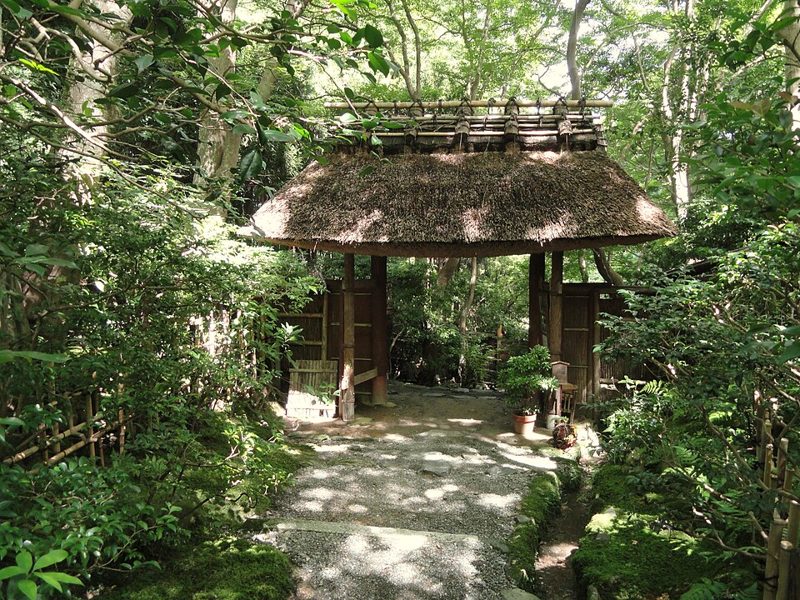
In 1895, Gioji was rebuilt with the support of nearby Daikakuji and the donation of a thatched-roof building by a former Kyoto governor. Yet the temple's story reaches back to The Tale of the Heike, the medieval narrative of the dancer Gio, her rejection by the powerful Taira no Kiyomori, and her decision to become a Buddhist nun. Today, a moss-covered garden, a circular Rainbow Window, wooden figures associated with the story, and memorial towers preserve the connection between literary tragedy and Buddhist reflection.
Kyochika's take
K
y
o
c
h
i
k
a
r
e
c
o
m
m
e
n
d
s
G
i
o
j
i
t
o
v
i
s
i
t
o
r
s
w
h
o
e
n
j
o
y
m
e
d
i
e
v
a
l
l
i
t
e
r
a
t
u
r
e
,
B
u
d
d
h
i
s
t
h
i
s
t
o
r
y
,
a
n
d
g
a
r
d
e
n
s
t
h
a
t
r
e
w
a
r
d
c
l
o
s
e
o
b
s
e
r
v
a
t
i
o
n
.
I
n
e
a
r
l
y
s
u
m
m
e
r
,
w
e
s
u
g
g
e
s
t
c
o
n
c
e
n
t
r
a
t
i
n
g
o
n
t
h
e
d
i
f
f
e
r
e
n
t
g
r
e
e
n
s
o
f
t
h
e
m
o
s
s
a
n
d
m
a
p
l
e
l
e
a
v
e
s
;
i
n
l
a
t
e
a
u
t
u
m
n
,
l
o
o
k
f
o
r
t
h
e
c
o
l
o
r
e
d
l
e
a
v
e
s
s
c
a
t
t
e
r
e
d
a
c
r
o
s
s
t
h
e
m
o
s
s
.
R
e
a
d
G
i
o
'
s
s
t
o
r
y
b
e
f
o
r
e
e
n
t
e
r
i
n
g
t
h
e
h
e
r
m
i
t
a
g
e
s
o
t
h
a
t
t
h
e
w
o
o
d
e
n
f
i
g
u
r
e
s
a
n
d
m
e
m
o
r
i
a
l
t
o
w
e
r
s
b
e
c
o
m
e
m
o
r
e
t
h
a
n
i
s
o
l
a
t
e
d
h
i
s
t
o
r
i
c
a
l
o
b
j
e
c
t
s
.
Hours, admission and access
- Hours
- 9:00–16:30 (last admission). The official visitor information states that visitors may remain until 16:50.
- Closed
- January 1. Kyoto City's official tourism guide also lists an earlier last admission time of 15:00 on December 31.
- Admission
- Adults ¥500; elementary, junior high, and high school students ¥100. Combined Gioji and Daikakuji admission ticket: ¥1,000 for adults. The combined ticket covers Daikakuji's temple hall area but not the Osawa Pond area.
- Access
- 32 Sagatoriimoto Kozakacho, Ukyo-ku, Kyoto. Kyoto City Bus to Saga Shakado-mae, followed by approximately 15 minutes on foot. Kyoto City's official tourism guide also lists Saga Shogakko-mae, followed by approximately 15 minutes on foot.
- Nearest station
- Saga-Arashiyama Station (JR Sagano Line)
Checked against official information on 2026-10-28. Details change, so check the official website before you go.
Sources: Japan Tourism Agency — Gioji Temple, Kyoto City Official Tourism Guide — Gioji, Kyoto City Official Travel Guide — Gioji, Kyoto Prefecture Tourism Federation — Gioji, Keihan Group — Gioji
 Pochikichi's story corner
How did a dancer's rejection become the story of a Buddhist temple?
Gioji's history is inseparable from The Tale of the Heike, the medieval military narrative describing the rise and fall of the Taira family. According to the story, Gio was a shirabyoshi, a female performer known for singing and dancing. She became a favorite of Taira no Kiyomori, the powerful military leader who lived from 1118 to 1181. Kiyomori's favor brought Gio material security and recognition, but her position depended entirely on his changing affection. Eventually, Kiyomori transferred his attention to another young performer named Hotoke Gozen. Gio lost her privileged position and was even required to perform for the woman who had replaced her. The episode exposes the instability of worldly success and the unequal power relationship between a performer and an influential political patron.
The Tale of the Heike describes Gio becoming so distressed that she considered ending her life. Instead, she left the capital with her younger sister Gijo and their mother Toji. The women entered Buddhist religious life at a hermitage belonging to Ojoin, a larger temple in the Okusaga area. Their withdrawal transformed the narrative from a story about competition for Kiyomori's attention into one about abandoning worldly attachments. Hotoke Gozen eventually recognized that her own favored position could also disappear. Seeking to make amends for Gio's suffering, she joined the women in religious life. The story concludes with the former rivals living together as Buddhist nuns. This account belongs to the literary tradition of The Tale of the Heike, rather than an independently verified record of every personal event.
The hermitage became associated with Gio's name after the decline of the larger Ojoin temple. Although Ojoin eventually fell into disrepair, the small religious community survived for a time. The Meiji government's separation of Shinto and Buddhism in 1868 contributed to the decline of many Buddhist institutions, including Gioji. The temple's Buddhist images and memorial objects were subsequently protected by nearby Daikakuji. In 1895, Gioji was restored with Daikakuji's assistance and the donation of a building by a former Kyoto governor. The present thatched-roof hermitage therefore does not date from Gio's lifetime. It represents a later effort to preserve the place and its literary associations.
Inside the hermitage, Dainichi Nyorai is enshrined as the principal Buddhist image. Wooden figures associated with Gio, Gijo, Toji, Hotoke Gozen, and Kiyomori give visible form to the narrative. The figures of Gio and Gijo are believed to date from the Kamakura period. Nearby are memorial towers associated with the women and Kiyomori. The garden, with its maple trees, extensive moss covering, camellias, stream, stone lanterns, and water feature, creates a setting in which the themes of change and impermanence can be considered through the seasons. So when you visit, look for the relationship between the figures in the hermitage, the memorial towers outside, and the garden's changing colors.
Sources: Japan Tourism Agency — Gioji Temple, Kyoto City Official Tourism Guide — Gioji, Kyoto Prefecture Tourism Federation — Gioji
Long ago, around hereWhat was here before the present hermitage?
The temple's earlier history is connected with Ojoin, a substantial Buddhist institution in the Okusaga area. The Tale of the Heike places Gio and her companions at a hermitage within its grounds. Over time, the larger temple declined, while the smaller religious site continued to preserve Gio's memory. The surviving sources establish this medieval connection but do not identify the precise appearance or arrangement of buildings at the present site approximately 1,200 years ago. It would therefore be misleading to describe the current moss garden or hermitage as an unchanged survival from that period. By approximately 400 years ago, the religious landscape had already undergone substantial transformation, although the opened sources do not document a precise plan of the site for that date.
Approximately 150 years ago, Gioji was experiencing the effects of the Meiji-period reorganization of religious institutions. The separation of Shinto and Buddhism ordered in 1868 contributed to the decline of the temple. Daikakuji protected the surviving Buddhist images and memorial objects, allowing the site's associations with Gio to endure. The restoration of 1895 provided a new physical setting for the story. The present building is therefore important not simply as traditional architecture, but as evidence of a later effort to preserve a literary and religious heritage that had survived the disappearance of earlier structures.
Sources: Japan Tourism Agency — Gioji Temple, Kyoto City Official Tourism Guide — Gioji
Hidden highlights
- Yoshino Window
- The circular window is also called the Rainbow Window. Sunlight filtered through the surrounding foliage produces changing colors on its paper screen, making the screen itself as important as the shape of the opening.
- The wooden figures of Gio and Gijo
- These figures are believed to date from the Kamakura period. Look closely at their faces and consider how the medieval performers were remembered through religious sculpture.
- The memorial tower for Gio, Gijo, and Toji
- The taller of the prominent memorial towers commemorates the women associated with Gio's story. Its presence gives the literary narrative a physical place of remembrance.
- Kiyomori's memorial tower
- A separate stone memorial commemorates Taira no Kiyomori. Its proximity to the women's memorial connects the powerful patron with the people whose lives were affected by his decisions.
- The moss garden
- The Japan Tourism Agency describes more than 20 kinds of moss within the temple garden. A display of moss samples helps visitors compare different textures and shades of green.
- The suikinkutsu
- This traditional garden water feature is included among the landscape elements described by the Japan Tourism Agency. It offers another detail to notice beyond the maple trees and moss.
Sources: Japan Tourism Agency — Gioji Temple, Kyoto Prefecture Tourism Federation — Gioji, Kyoto City Official Tourism Guide — Gioji
Why did Hotoke Gozen follow the woman she had replaced?
In The Tale of the Heike, Hotoke Gozen initially appears as the performer whose arrival changes Gio's life. Kiyomori abandons Gio in favor of Hotoke, leaving the former favorite humiliated and without the security she had enjoyed. Yet Hotoke's position is also precarious. She recognizes that the same change of affection could eventually happen to her. The story describes her seeking out Gio and her companions after they have entered religious life.
Hotoke's decision gives the episode its distinctive moral conclusion. Instead of remaining rivals, the women are reunited through Buddhist practice. Their shared religious life suggests that compassion can replace competition and that worldly status is inherently unstable. Visitors looking at their wooden figures in the hermitage encounter the story's conclusion rather than the moment of rivalry that made the narrative famous.
Sources: Japan Tourism Agency — Gioji Temple
How did a later restoration preserve Gio's story?
Gioji's thatched-roof hermitage looks appropriate to its medieval literary associations, but the building is not an original structure from The Tale of the Heike. After the temple's decline in the Meiji period, Daikakuji protected its religious images and memorial objects. The restoration in 1895 depended on support from the neighboring temple and a building donated by a former Kyoto governor.
This history adds another dimension to a visit. The temple is not simply a place where an old story is remembered; it is also a place where later generations deliberately protected that memory. The building, sculptures, stones, and garden belong to different historical layers, united by the continuing significance of Gio's story.
Sources: Japan Tourism Agency — Gioji Temple
How to walk it
- Temple entrance — Begin with the relationship between the modest thatched hermitage and the surrounding vegetation. (3 min)
- Moss garden — Follow the permitted paths and compare the textures of the moss, maple foliage, and other garden plants. (7 min)
- Thatched hermitage — Examine the building's traditional form and consider its role in the temple's restoration. (4 min)
- Wooden figures — Look for Dainichi Nyorai and the figures associated with Gio, her companions, and Kiyomori. Do not photograph the Buddhist statues. (6 min)
- Yoshino Window — Study the circular window and the effects of light filtered through the surrounding leaves. (4 min)
- Memorial towers — Observe the towers commemorating Gio and her companions, and the separate memorial to Kiyomori. (5 min)
- Garden details — Look for the moss display, stone lanterns, stream, and suikinkutsu before leaving. (3 min)
All durations are Kyochika editorial estimates, not official visiting times. The suggested walk totals approximately 32 minutes. Follow the temple's permitted paths and any instructions displayed on site.
Sources: Japan Tourism Agency — Gioji Temple
Through the seasons
- Spring
- Look for developing maple foliage and the different forms of vegetation around the moss garden.
- Early summer
- The green maple canopy and moss provide an opportunity to compare shades and textures of foliage.
- Mid-November to early December
- Kyoto City's official tourism guide identifies this period with fallen red and yellow maple leaves covering the moss garden.
- Winter
- Focus on the thatched hermitage, stone memorials, and the garden's structure as seasonal foliage changes.
Getting there by taxi or bus
- Taxi
- Use the destination name Gioji Temple and the address in Sagatoriimoto Kozakacho. A verified taxi fare or travel time was not available.
- Bus
- Kyoto City Bus to Saga Shakado-mae (嵯峨釈迦堂前), followed by approximately 15 minutes on foot. Kyoto City's official tourism guide also lists Saga Shogakko-mae (嵯峨小学校前), followed by approximately 15 minutes on foot. Route numbers were not verified.
- Other
- Saga-Arashiyama Station is the JR rail approach. Keihan Group also lists Randen Arashiyama Station as a walking approach to the temple.
Sources: Kyoto Prefecture Tourism Federation — Gioji, Kyoto City Official Tourism Guide — Gioji, Keihan Group — Gioji
Pair it with
- Adashino Nenbutsuji Temple — Explore another Buddhist site associated with impermanence and the remembrance of the dead. (Walking time not verified. min walk)
- Nison-in Temple — Continue exploring the religious heritage of the Okusaga district. (Walking time not verified. min walk)
- Daikakuji Temple — Visit the temple associated with Gioji's preservation and the combined admission ticket. (Walking time not verified from an opened current source. min walk)
Good to know before you go
- The current admission price is ¥500 for adults and ¥100 for elementary, junior high, and high school students.
- The adult combined ticket for Gioji and Daikakuji costs ¥1,000 and does not include Daikakuji's Osawa Pond area.
- The official visitor information states that last admission is 16:30 and visiting may continue until 16:50.
- The temple's published guidance prohibits photographing Buddhist statues inside the hermitage.
- Tripods and monopods, including those used with smartphones, are prohibited on the grounds.
- The temple reports that there are no visitor toilets within the grounds.
- The temple prohibits pets, including those in carriers or on leashes, with exceptions for guide dogs and hearing dogs.
- Commercial filming, photography, interviews, and publication requests require advance permission. The temple asks for inquiries at least two weeks beforehand.
- The Kyoto Prefecture Tourism Federation lists the grounds as inaccessible to wheelchairs and reports no wheelchair-accessible toilet.
- The Kyoto Prefecture Tourism Federation lists no parking, while the temple's current published guidance mentions limited parking spaces. Visitors should not depend on on-site parking.
- Kyoto City's official tourism guide lists a 15:00 last admission on December 31.
- Individual cashless payment availability and on-site English audio-guide provision were not confirmed.
Next stop: book for later today PR
Tickets and experiences in Kyoto you can book on Klook. Filter by “Today” to see what is still open.
Kimono rental in Kyoto→Tea ceremony experiences in Kyoto→Kyoto one-day sightseeing tours→All things to do in Kyoto on Klook →Compare on GetYourGuide: Kimono rental in Kyoto · Tea ceremony experiences in Kyoto · Kyoto one-day sightseeing tours
Ad: Klook and GetYourGuide affiliate links.
Tips from visitors
Been here? Leave a short tip for the next traveler — in any language. No name, no sign-up.
Thank you! We check every tip by hand and post it within a day or two.
How we post tips: we read every one before it goes up. We remove swear words, insults, ads, links and anything that could identify a person. Tips are shown in the language they were written in, with a translate link. Kyochika never writes or pays for tips, and there are no star ratings.
FAQ
- What is Gioji Temple?
- In 1895, Gioji was rebuilt with the support of nearby Daikakuji and the donation of a thatched-roof building by a former Kyoto governor. Yet the temple's story reaches back to The Tale of the Heike, the medieval narrative of the dancer Gio, her rejection by the powerful Taira no Kiyomori, and her decision to become a Buddhist nun. Today, a moss-covered garden, a circular Rainbow Window, wooden figures associated with the story, and memorial towers preserve the connection between literary tragedy and Buddhist reflection.
- Hours at Gioji Temple?
- 9:00–16:30 (last admission). The official visitor information states that visitors may remain until 16:50.
- Closed at Gioji Temple?
- January 1. Kyoto City's official tourism guide also lists an earlier last admission time of 15:00 on December 31.
- Admission at Gioji Temple?
- Adults ¥500; elementary, junior high, and high school students ¥100. Combined Gioji and Daikakuji admission ticket: ¥1,000 for adults. The combined ticket covers Daikakuji's temple hall area but not the Osawa Pond area.
- Access at Gioji Temple?
- 32 Sagatoriimoto Kozakacho, Ukyo-ku, Kyoto. Kyoto City Bus to Saga Shakado-mae, followed by approximately 15 minutes on foot. Kyoto City's official tourism guide also lists Saga Shogakko-mae, followed by approximately 15 minutes on foot.
- Is Gioji the original temple from The Tale of the Heike?
- No. The site preserves the story's religious associations, but the present hermitage was restored in 1895 after the decline of earlier religious buildings.
- Can visitors photograph the Buddhist figures?
- No. The temple's published guidance prohibits photography of the Buddhist statues inside the hermitage.
- When should I visit for autumn leaves?
- Kyoto City's official tourism guide identifies mid-November to early December as a period when fallen red and yellow maple leaves cover the moss garden. Actual seasonal conditions vary.
- Does the combined ticket include Daikakuji's pond?
- No. The ¥1,000 adult combined ticket includes Gioji and Daikakuji's temple hall area but excludes the Osawa Pond area.